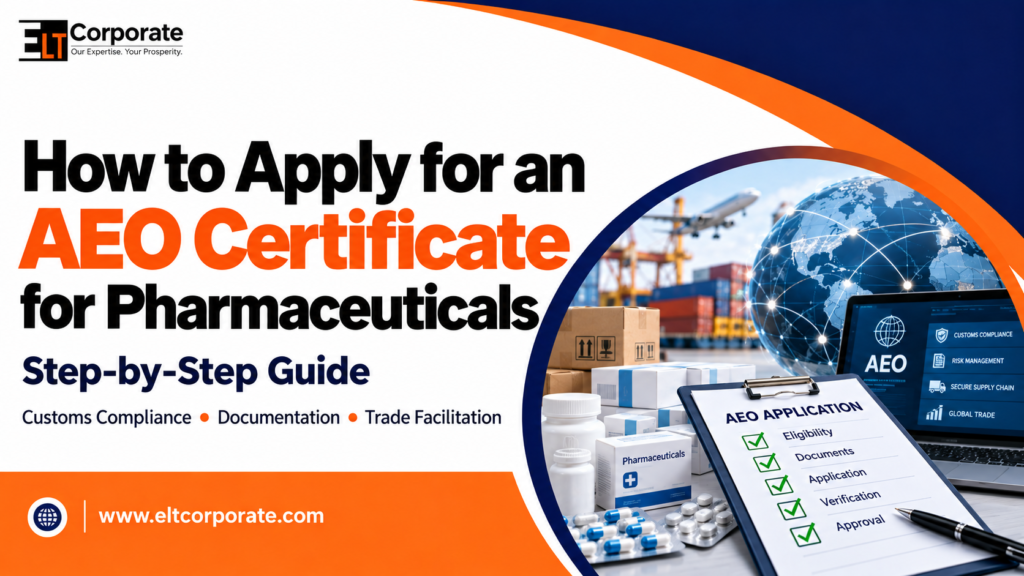
Pharmaceutical companies involved in international trade regularly deal with customs clearance, imports of raw materials and equipment, exports of finished medicines, international logistics, and supply chain compliance. Obtaining an AEO Certificate for Pharmaceuticals can help eligible businesses benefit from faster and more predictable customs procedures.
The Authorised Economic Operator (AEO) Programme is administered by Indian Customs under the Central Board of Indirect Taxes and Customs (CBIC). It recognizes eligible businesses that demonstrate customs compliance, reliable record management, financial solvency, and, for higher tiers, appropriate supply chain security controls.
For pharmaceutical manufacturers, exporters, and importers, AEO certification in India can therefore become an important part of an efficient international trade and supply-chain strategy.
What is an AEO Certificate for Pharmaceuticals?
An AEO Certificate for Pharmaceuticals refers to AEO status obtained by an eligible pharmaceutical company participating in the international supply chain.
It is important to understand that Indian Customs does not issue a separate category of AEO certification for pharmaceuticals. Pharmaceutical manufacturers, importers, and exporters apply under the same AEO framework applicable to other eligible international trade entities.
The program currently provides AEO-T1, AEO-T2, and AEO-T3 status for eligible importers/exporters, while AEO-LO is intended for eligible logistics operators.
What does AEO mean?
AEO stands for Authorised Economic Operator.
An AEO is essentially a trusted international trade participant recognised by Customs for maintaining specified standards relating to compliance, record-keeping, financial standing and, depending on the applicable tier, supply chain security.
For pharmaceutical businesses, AEO certification in India can support smoother customs operations where the company regularly imports or exports products, ingredients, equipment, or other goods.
Who can apply for an AEO Certificate for Pharmaceuticals?
A pharmaceutical company may consider applying for an AEO Certificate for Pharmaceuticals when it is involved in customs-related international trade activities.
Typical applicants may include:
– Pharmaceutical manufacturers that import raw materials or export medicines
– API manufacturers and exporters
– Pharmaceutical importers
– Pharmaceutical exporters
– Healthcare product manufacturers involved in international trade
– Eligible MSME pharmaceutical companies
– Companies importing pharmaceutical manufacturing equipment or other goods as part of their regular business
The applicant must be a legal entity participating in the international supply chain and carrying out Customs-related activities.
What are the different AEO categories for pharmaceutical companies?
AEO-T1
AEO-T1 is generally the entry-level AEO status available to qualifying importers and exporters.
Applicants are assessed principally against requirements relating to general eligibility, legal compliance, commercial and transport record management and financial solvency.
AEO-T2
AEO-T2 provides a higher level of facilitation and involves more detailed assessment of the company’s processes and supply-chain security arrangements.
Premises and operating controls may be verified by the AEO Program Team.
AEO-T3
AEO-T3 represents the highest tier for eligible importers/exporters. It is available to qualifying AEO-T2 entities subject to the prescribed conditions.
A company should therefore determine the appropriate tier before starting an application for an AEO Certificate for Pharmaceuticals.
What are the basic eligibility requirements for an AEO Certificate for Pharmaceuticals?
Eligibility depends on the applicable AEO rules and tier. As a general principle, an applicant should:
– Be involved in the international supply chain
– Undertake customs-related activity
– Maintain a satisfactory compliance record
– Maintain auditable commercial and transport records
– Demonstrate financial solvency
– Maintain documented processes and internal controls
– Meet applicable safety and security requirements for higher AEO tiers
The AEO portal currently identifies documented processes, compliance readiness, and defined responsibilities for compliance, record management, and security as important readiness areas.
Eligible MSMEs receive certain relaxed criteria under the program. For example, has reduced some document-volume and business-history requirements for qualifying MSMEs.
How to apply for an AEO Certificate for Pharmaceuticals step-by-step?
Step 1: Determine the appropriate AEO tier.
Before applying for an AEO Certificate for Pharmaceuticals, determine whether the company should apply for AEO-T1 or AEO-T2.
A company beginning its AEO journey may consider T1 where appropriate, while organizations with mature internal controls and supply-chain security systems may evaluate T2.
Step 2: Conduct an AEO eligibility assessment.
Review the company’s
– Import and export history
– Customs compliance
– IEC details
– GST and legal entity information
– Financial records
– Customs notices or proceedings, where applicable
– Commercial record-keeping systems
– Internal SOPs
– Supply-chain security arrangements
– Warehouse and premises controls
A readiness assessment before filing AEO certification in India can identify gaps that may otherwise lead to queries during scrutiny.
Step 3: Keep the IEC and company information ready.
New applicants must register on the official AEO portal.
The current applicant registration process requires AEO certification in India and the entity name to correspond with the IEC records. Applicants are also instructed to upload their IEC certificate together with the relevant IEC profile information from the DGFT portal.
Therefore, inconsistencies between IEC, company, and application details should ideally be corrected before filing.
Step 4: Prepare the required documents.
The documents required for an AEO Certificate for Pharmaceuticals depend on the applicable tier and applicant profile.
Common supporting areas include:
– IEC details
– Company/entity details
– Authorization or declaration
– Import/export information
– Legal compliance details
– Financial solvency evidence
– Commercial and transport record procedures
– Relevant SOPs
– Organization and responsibility details
For T2 applications, the documentation extends further into areas such as:
– Security plan
– Process map
– Site plan
– General compliance
– Legal compliance
– Commercial and transport records
– Financial solvency
– Safety and security arrangements
Applicants should always use the latest official forms and checklists available on the AEO portal.
Step 5: Strengthen pharmaceutical supply-chain documentation
Although the AEO Programme is not a pharmaceutical product approval scheme, pharmaceutical companies should ensure that their trade-related controls are properly documented.
Relevant supporting evidence may include SOPs relating to:
– Import and export documentation
– Warehouse access
– Material movement
– Vendor management
– Cargo handling
– Transport security
– Visitor management
This makes an application for AEO certification in India easier to substantiate because Customs can assess not merely what an SOP says, but whether it is actually implemented.
Step 6: Register and submit the application
The applicant should register and apply through the official Indian Customs AEO portal.
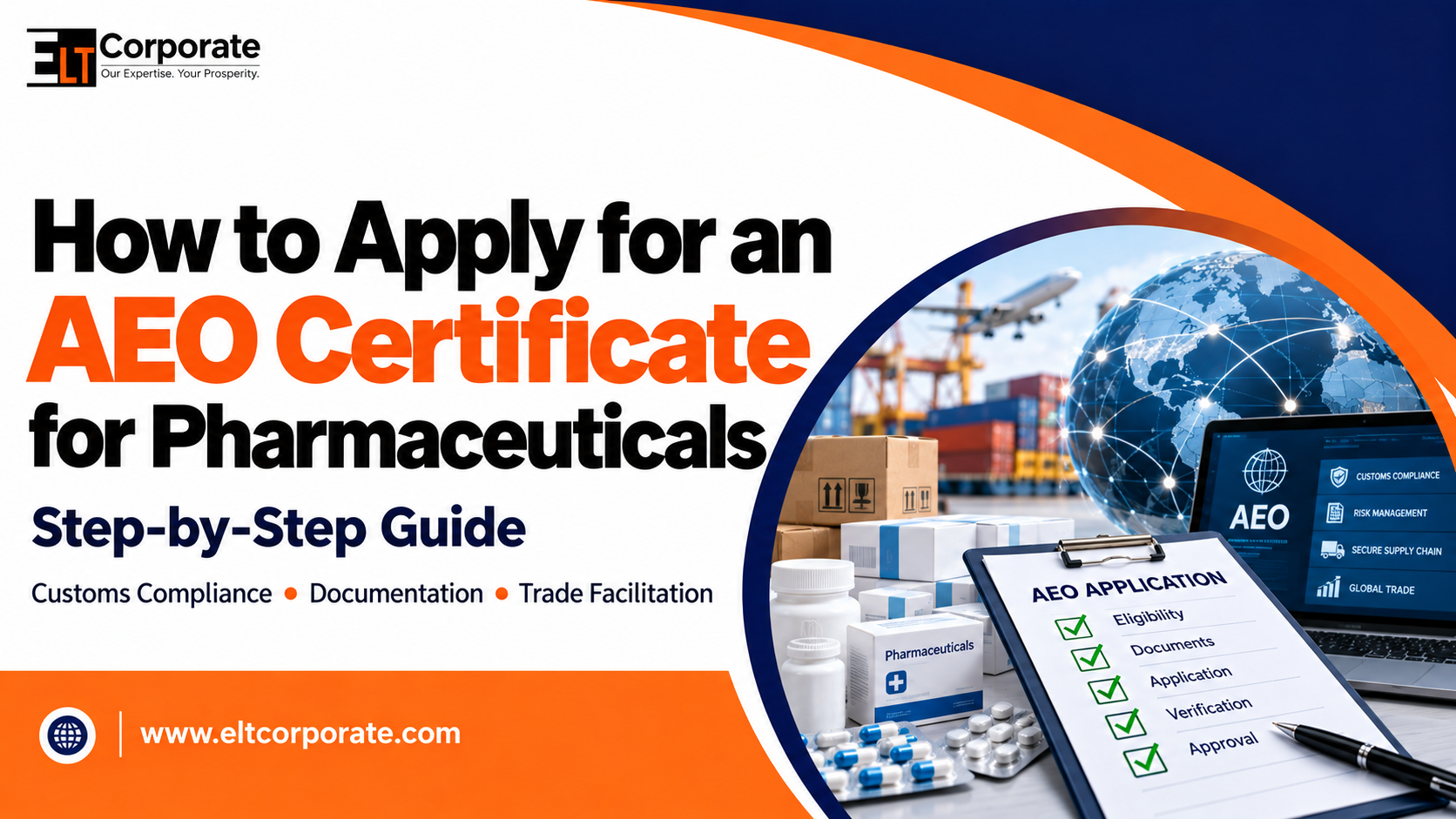
The current application journey broadly consists of:
Prepare → Submit → Desk Review → Verification → Decision
New users create an applicant account, select the relevant category/tier, complete the application, and provide supporting documentation.
There is currently no fee charged by Indian Customs for filing an AEO application.
Step 7: Respond to Customs queries.
After submission, the AEO authorities examine the application and supporting records.
If any information is incomplete, inconsistent, or unclear, the applicant may be asked for clarification or additional evidence.
Common reasons for delay include:
– Incomplete documents
– Different names or addresses across records
– SOPs without implementation evidence
– Slow responses to clarification requests
– Incomplete compliance information
An application for an AEO Certificate for Pharmaceuticals should therefore be internally reviewed before final submission.
Step 8: Prepare for verification where applicable.
For applications requiring verification, the AEO team may examine relevant records, systems, controls, and premises.
Verification may include:
– Review of SOP implementation
– Examination of records and logs
– Review of access and security controls
– Discussion with management and responsible employees
– Walk-through of operational areas
– Review of corrective actions where gaps are identified
This is particularly significant for T2 applications.
Step 9: Receive the AEO decision
After satisfactory examination and applicable verification, the competent authority processes the application for certification.
The official portal currently indicates an indicative timeline of 30 days for AEO-T1 after receipt of complete information/documents. For eligible MSME T1 applications, the stated processing target is 15 working days after complete documentation.
T2 involves additional scrutiny and verification stages, so the process may take longer.
What are the benefits of an AEO Certificate for Pharmaceuticals?
An AEO Certificate for Pharmaceuticals can provide qualifying businesses with customs facilitation benefits depending on their AEO tier.
- Potential benefits include:
- Faster customs clearance
- Reduced routine interventions on a risk basis
- Direct Port Delivery for eligible imports
- Direct Port Entry for eligible exports
- Reduced Bank Guarantee requirements subject to conditions
For pharmaceutical businesses dealing with time-sensitive materials and international shipments, these benefits can improve supply-chain planning and operational efficiency.
How long does AEO certification in India take?
The exact time depends on the tier, completeness of documentation, clarifications, and verification requirements.
For AEO-T1, the official AEO portal currently indicates certification within approximately 30 days after complete information and documentation are available.
Eligible MSME T1 applications have a targeted processing period of 15 working days, while Eligible MSME T2 applications are targeted for processing within three months after submission of complete documents.
These are indicative timelines rather than a guarantee for every application.
Is CDSCO approval required for an AEO Certificate for Pharmaceuticals?
AEO and CDSCO approvals serve different regulatory purposes.
CDSCO regulates drugs, medical devices, and other products falling within its statutory jurisdiction.
AEO certification, on the other hand, is a customs trade-facilitation program.
Accordingly, obtaining AEO certification in India does not replace pharmaceutical licences, CDSCO approvals, import licences or other product-specific regulatory requirements that may apply to the goods being traded.
Is an AEO Certificate mandatory for pharmaceutical exporters?
No. An AEO Certificate for Pharmaceuticals is not generally a mandatory pharmaceutical manufacturing or export licence.
It is a voluntary customs compliance and trade-facilitation program for eligible economic operators.
However, businesses with regular international trade may consider it valuable because of the customs and supply-chain facilitation benefits available to certified entities.
What mistakes should pharmaceutical companies avoid during an AEO application?
Companies should avoid:
- Filing before checking eligibility
- Mismatch in IEC and legal entity information
- Incomplete customs compliance disclosures
- Generic SOPs that are not actually implemented
- Missing evidence or logs
- Poorly documented security controls
For successful AEO certification in India, documents should reflect the company’s actual business processes rather than being created merely to complete the application.
Conclusion
An AEO Certificate for Pharmaceuticals can be valuable for pharmaceutical manufacturers, importers, and supply chain exporters that regularly participate in international trade. The process starts with choosing the correct AEO tier, assessing eligibility, organizing legal and financial records, preparing Customs and supply-chain SOPs, submitting the application, and responding to any verification requirements.
A well-prepared application for AEO certification in India should demonstrate not only documented procedures but also actual compliance and implementation. Pharmaceutical businesses that maintain strong Customs controls, accurate records, and secure supply-chain practices can use AEO status to make international trade more efficient, predictable, and compliant.
Frequently Asked Questions
Q.1 Is there a separate AEO certificate for pharmaceuticals?
No. Pharmaceutical importers, exporters, and manufacturers apply under the general Indian Customs AEO Program based on their eligibility and international trade activities.
Q.2 Can a pharmaceutical manufacturer apply for AEO-T1?
Yes, an eligible pharmaceutical manufacturer undertaking qualifying import/export and customs-related activities may apply for the appropriate AEO tier.
Q.3 Is there a government fee for applying for an AEO Certificate for Pharmaceuticals?
Indian Customs currently states that no government fee is charged for filing an AEO application.
Q.4 Where is the application submitted?
Applications are managed through the official Indian Customs AEO portal at aeoindia.gov.in.
Q.5 Why should pharmaceutical companies consider an AEO Certificate for Pharmaceuticals?
The certification can help eligible pharmaceutical businesses achieve faster customs facilitation and improved supply chain predictability.