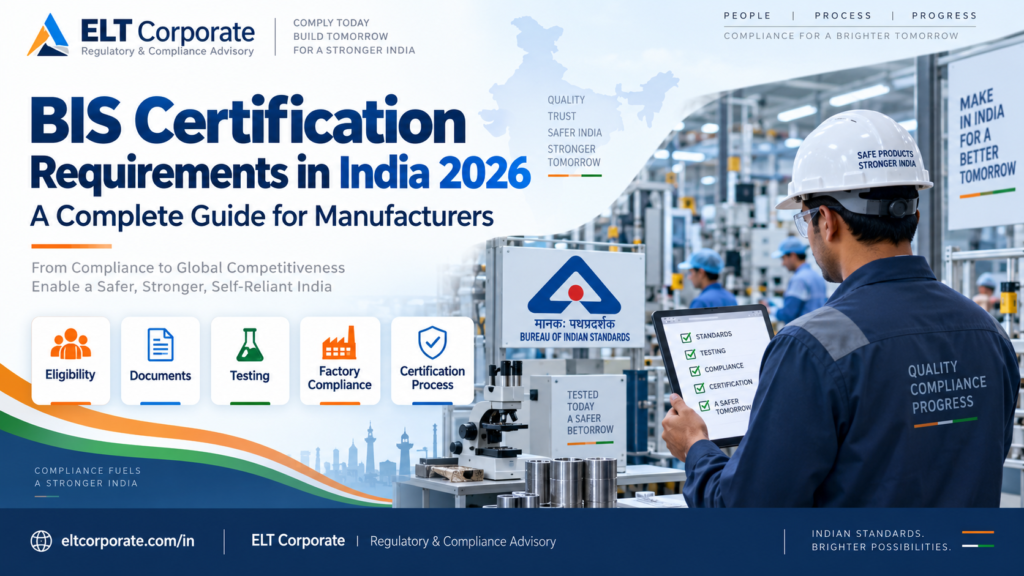
In India’s rapidly growing manufacturing sector, product quality, consumer safety, and regulatory compliance have become essential for successful business operations. Manufacturers must ensure that their products comply with applicable Indian Standards, particularly when certification is mandatory under government regulations.
Understanding the BIS Certification Requirements in India is crucial for domestic and foreign manufacturers seeking to manufacture, import, sell, or distribute regulated products in the Indian market.
The Bureau of Indian Standards (BIS) is India’s National Standards Body, responsible for standards formulation, conformity assessment, and product certification.
In 2026, manufacturers must also monitor changes in Quality Control Orders (QCOs), applicable Indian Standards, and certification procedures.
This comprehensive guide explains the BIS Certification Requirements in India, including eligibility, certification schemes, documents, testing, application procedures, fees, and compliance obligations.
What Are the BIS Certification Requirements in India?
BIS Certification Requirements in India refer to the regulatory, technical, and documentary conditions that manufacturers must satisfy to obtain certification or registration for products covered under the applicable BIS conformity assessment scheme.
BIS certification establishes that a product conforms to the relevant Indian Standard and applicable scheme requirements.
Although BIS Certification Requirements in India are generally voluntary, the Central Government makes certification mandatory for specified products through Quality Control Orders and other applicable regulatory provisions.
Manufacturers should therefore determine whether their products require mandatory certification before placing them on the Indian market.
Why Are BIS Certification Requirements in India Important in 2026?
BIS Certification Requirements in India support product safety, quality assurance, and regulatory compliance.
Its importance for manufacturers includes:
- Legal Compliance: Helps manufacturers meet applicable mandatory certification requirements.
- Consumer Confidence: Demonstrates conformity with relevant Indian Standards.
- Market Access: Allows eligible certified products to enter regulated Indian markets.
- Quality Improvement: Encourages appropriate manufacturing controls and testing procedures.
- Business Credibility: Strengthens confidence among distributors, customers, and commercial partners.
- Regulatory Risk Reduction: Helps avoid violations arising from non-compliant products or unauthorised use of BIS marks.
Manufacturers should continuously monitor regulatory notifications because product coverage and implementation deadlines may change.
Types of Certification Under BIS Certification Requirements in India
Different product categories fall under different BIS conformity assessment schemes.
| Certification Scheme | Applicability |
| Scheme I – ISI Mark | Product certification for applicable Indian Standards |
| Scheme II – CRS | Compulsory Registration Scheme for notified product categories, including specified electronics and IT goods |
| FMCS | BIS certification route for eligible foreign manufacturers |
| Scheme IV – CoC | Certificate of Conformity for specified products |
| Scheme X | Certification for products notified under the applicable Scheme X framework |
Important: FMCS is a route for foreign manufacturers under BIS Certification Requirements in India relevant product certification framework, not a substitute for CRS for notified electronics and IT products.
Manufacturers must identify the applicable scheme based on the product, Indian Standard, and relevant government notification.
Eligibility Criteria Under BIS Certification Requirements in India
Eligibility varies according to the certification scheme, but manufacturers generally need to demonstrate the following:
- Manufacturing Facility: The applicant must operate identifiable manufacturing premises for the relevant product.
- Applicable Indian Standard: The product must fall within the scope of the Indian Standard against which certification is sought.
- Manufacturing Infrastructure: Appropriate machinery, equipment, and production facilities must be available.
- Quality Control: Suitable procedures should exist to monitor product conformity.
- Testing Capability: Testing arrangements must satisfy the requirements of the applicable standard and certification scheme.
- Regulatory Documentation: The manufacturer must provide the prescribed application information and supporting documents.
Under FMCS, foreign manufacturers must also meet applicable Indian representative and scheme-specific requirements.
Step-by-Step Process for BIS Certification Requirements in India
For Scheme I, BIS assesses relevant manufacturing infrastructure, process controls, and testing capabilities.
Step 1: Identify Product Applicability
Determine whether the product falls under mandatory BIS certification by reviewing the applicable Indian Standard and Quality Control Order.
Verify the latest enforcement date and any applicable exemptions.
Step 2: Select the Certification Scheme
Identify whether the product requires ISI certification, CRS registration, FMCS certification, Scheme IV conformity assessment, or Scheme X certification.
Step 3: Prepare Manufacturing Infrastructure
Ensure that the manufacturing facility has adequate BIS Certification Requirements in India production equipment, quality control systems, and testing arrangements.
Step 4: Arrange Product Testing
Where required, arrange testing through a BIS-recognized BIS Certification Requirements in India laboratory or another testing route permitted under the applicable scheme.
Testing must establish conformity with the relevant Indian Standard.
Step 5: Prepare Application Documents
Complete the prescribed application forms and collect supporting technical and business records.
Information regarding products, manufacturing locations, equipment, and quality controls should be accurate.
Step 6: Submit the Application
Submit the application through the relevant BIS portal.
For domestic product certification, manufacturers generally use:
For CRS, applicants should follow the applicable BIS CRS application process.
Step 7: Factory Inspection or Verification
BIS may conduct factory assessments to verify manufacturing infrastructure, quality control procedures, and testing facilities.
The nature of verification depends on the BIS Certification Requirements in India applicable to the certification scheme. CRS registration does not ordinarily follow the same factory inspection procedure as Scheme I.
Step 8: Grant of Licence or Registration
After satisfactory assessment and completion of applicable requirements, BIS may grant the relevant license, registration, or Certificate of Conformity.
Only products covered by a valid authorization may carry the applicable BIS Certification Requirements in India marked in accordance with the prescribed conditions.
BIS ISI Mark and BIS Certification Requirements in India
The ISI Mark is one of India’s most recognized product conformity marks.
Under Scheme I, manufacturers must demonstrate BIS Certification Requirements in India that their products comply with the applicable Indian Standard.
The certification process generally includes assessment of manufacturing infrastructure, process controls, testing facilities, and product conformity.
Manufacturers must also follow applicable marking and surveillance requirements after licence approval.
The ISI Mark must not be used before the manufacturer receives the required authorization.
BIS CRS Registration and BIS Certification Requirements in India
The Compulsory Registration and BIS Certification Requirements in India apply to specified notified products, including various electronics and IT goods.
Depending on the applicable notification, covered products include categories such as laptops, certain televisions, and other notified electronic equipment.
The process generally involves identification of the BIS Certification Requirements in India applicable to the standard, product testing through a recognized laboratory, submission of the prescribed application, and BIS scrutiny.
Manufacturers should verify the latest product list and applicable Indian Standard because regulatory requirements and standards may be amended.
Foreign Manufacturers and BIS Certification Requirements in India
Foreign manufacturers seeking access to the Indian market BIS Certification Requirements in India may need certification under the Foreign Manufacturers Certification Scheme (FMCS).
The manufacturer must demonstrate product conformity and satisfy the relevant manufacturing and testing requirements.
An eligible, authorized Indian representative must be nominated in accordance with BIS provisions.
A significant 2026 procedural update is that FMCS applications have been accepted exclusively through the online portal since 1 June 2026, with the previous hard-copy application route discontinued.
Separate applications are generally required for each applicable product/Indian Standard and factory location.
BIS Certification Fees Under BIS Certification Requirements in India
The overall cost depends on the certification scheme, product category, testing requirements, and manufacturing location.
Applicable expenses may include:
- Application fees.
- Product testing charges.
- Inspection or audit charges.
- Licence or registration fees.
- Marking fees, where applicable.
- Foreign inspection-related expenses under FMCS.
- Professional consultancy charges, if engaged.
There is no single universal fee for all BIS certifications.
Manufacturers should refer to the latest official BIS fee schedule before estimating certification expenses.
Common Challenges with BIS Certification Requirements in India
Manufacturers may face delays or compliance difficulties due to:
Incorrect Standard Selection: Applying against an unsuitable Indian Standard can result in technical complications.
Incomplete Documentation: Missing technical records or inaccurate factory information may lead to queries.
Product Test Failures: Non-conforming samples may require corrective action and retesting.
Inadequate Testing Infrastructure: Insufficient testing arrangements can affect certification readiness.
QCO Changes: Manufacturers may overlook amendments, implementation dates, or revised product coverage.
A structured compliance assessment before application helps reduce these risks.
Maintaining Compliance with BIS Certification Requirements in India
Certification requires ongoing compliance rather than a one-time application.
Manufacturers should:
- Maintain conformity with applicable Indian Standards.
- Follow prescribed testing and inspection procedures.
- Maintain relevant production and quality records.
- Cooperate with applicable BIS surveillance activities.
- Renew licenses or registrations as required.
- Obtain applicable approvals for changes in certification scope.
- Monitor revisions to relevant standards and QCOs.
Non-compliance may result in regulatory action, including BIS Certification Requirements in India suspension or cancellation of certification under applicable provisions.
Documents Required for BIS Certification Requirements in India
Documentation is an important component of the BIS Certification Requirements in India certification process.
Commonly required or relevant documents include:
- Factory registration or legal establishment documents.
- Manufacturing premises address and location details.
- Product description and applicable Indian Standard.
- Manufacturing process flowchart.
- List of manufacturing machinery and equipment.
- List of testing equipment and calibration records.
- Quality control and inspection procedures.
- Details of technical and quality control personnel.
- Product test reports, where required.
- Authorized signatory details.
- Trademark or brand details, where applicable.
- Prescribed declarations and application forms.
Foreign manufacturers may additionally require an Authorised Indian Representative (AIR) nomination and other FMCS-specific documentation.
The exact checklist depends on the certification scheme, product category, and relevant BIS guidelines.
Why Choose ELT Corporate for BIS Certification Requirements in India?
Understanding BIS regulations, identifying product applicability, and preparing technical documentation can be challenging for manufacturers.
ELT Corporate Pvt. Ltd. provides professional regulatory consultancy services to domestic and foreign manufacturers seeking BIS certification in India.
Our assistance includes:
- BIS applicability and QCO assessment.
- Identification of relevant Indian Standards.
- ISI, CRS, and FMCS application guidance.
- Technical documentation preparation.
- Product testing coordination.
- Factory inspection readiness support.
- Application filing and query handling.
- Licence renewal and ongoing compliance assistance.
ELT Corporate helps manufacturers navigate the BIS Certification Requirements in India through a structured regulatory approach.
Conclusion
Meeting the BIS Certification Requirements in India is essential for manufacturers whose products fall under mandatory certification regulations.
From identifying the correct Indian Standard to preparing documents, arranging product testing, and maintaining manufacturing compliance, each stage requires careful attention.
Manufacturers should regularly review QCO amendments and BIS updates to ensure that their products remain compliant with applicable requirements.
ELT Corporate Pvt. Ltd. provides professional assistance with BIS certification, regulatory documentation, product testing coordination, and compliance management.
Frequently Asked Questions
Q1. Is BIS certification mandatory for every manufacturer?
No. BIS certification is mandatory for products covered by applicable compulsory certification notifications or QCOs. Other products may qualify for voluntary certification.
Q2. Can foreign manufacturers obtain BIS certification?
Yes. Eligible foreign manufacturers can apply through the relevant certification route, including FMCS for applicable products.
Q3. Is factory inspection mandatory for BIS certification?
It depends on the scheme. Factory verification generally forms part of Scheme I, while CRS follows a different registration and testing procedure.
Q4. Can one BIS licence cover multiple factories?
Manufacturing locations generally require separate certification applications, subject to the applicable scheme provisions.
Q5. How long does BIS certification take?
Timelines vary depending on the certification scheme, product testing, document completeness, inspection requirements, and departmental processing.