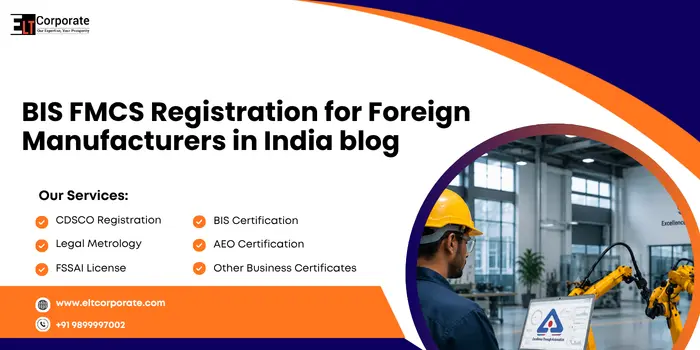
Entering the Indian market as a foreign manufacturer is a massive opportunity—but it also comes with strict compliance requirements. One of the most important approvals is BIS FMCS Registration under the Foreign Manufacturers Certification Scheme (FMCS). This certification allows overseas manufacturers to use the ISI mark on their products and legally sell them in India.
For foreign companies planning to export products to India, understanding the BIS FMCS process is essential to avoid delays, rejections, and compliance risks.
What is BIS FMCS?
BIS FMCS stands for Foreign Manufacturers Certification Scheme introduced by the Bureau of Indian Standards (BIS). Under this scheme, foreign manufacturers can obtain permission to use the ISI mark on products covered under mandatory BIS certification.
If a product falls under a mandatory Quality Control Order (QCO), it cannot be imported, sold, or distributed in India without BIS certification.
The FMCS scheme ensures that imported products meet Indian safety, quality, and performance standards before entering the Indian market.
Why is BIS FMCS Registration Important?
BIS FMCS certification is important because it:
- Ensures compliance with Indian regulations
- Allows legal sale of products in India
- Builds consumer trust through the ISI mark
- Prevents customs clearance issues
- Reduces risk of penalties and product recalls
Without FMCS approval, many regulated products cannot be imported into India.
Who Needs BIS FMCS Registration?
BIS FMCS registration is mandatory if:
- You are a foreign manufacturer
- Your product is covered under mandatory BIS certification
- You want to export products to India
- Your product requires the ISI mark
The certification is applicable only to manufacturers located outside India.
Common Products Covered Under BIS FMCS
Several categories of products require FMCS certification before entering the Indian market.
Electrical and Electronic Products
- Switches
- Cables
- Electrical appliances
- Circuit breakers
Steel and Construction Materials
- Steel products
- Cement
- Pipes and fittings
Chemicals and Industrial Products
- Industrial chemicals
- Fertilizers
- Packaging materials
Automotive Components
- Tyres
- Automotive parts
- Safety components
Household and Consumer Products
- Kitchen appliances
- Pressure cookers
- Household accessories
BIS FMCS Registration Process
The BIS FMCS registration process involves multiple stages and requires coordination with BIS authorities, laboratories, and auditors.
1. Identification of Applicable Indian Standard
The first step is identifying the correct Indian Standard (IS Code) applicable to the product.
Manufacturers must ensure that the product complies with all technical, quality, and safety requirements mentioned in the applicable standard.
2. Appointment of Authorized Indian Representative (AIR)
Foreign manufacturers must appoint an Authorized Indian Representative (AIR).
The AIR acts as the official liaison between the foreign manufacturer and BIS authorities in India.
3. Documentation Preparation
All technical and compliance-related documents must be prepared carefully before application submission.
This includes:
- Product specifications
- Manufacturing process details
- Quality manuals
- Test reports
- Factory information
4. Submission of BIS Application
The FMCS application is submitted to BIS along with:
- Prescribed government fees
- Supporting documents
- Technical details
- Product information
5. Factory Inspection by BIS Officials
BIS officials conduct an inspection of the foreign manufacturing facility.
The inspection verifies:
- Manufacturing capability
- Quality control systems
- Production process
- Testing infrastructure
- Calibration systems
This is one of the most critical stages of FMCS approval.
6. Product Sample Testing
Product samples are tested in BIS-approved laboratories according to the relevant Indian Standard.
Testing confirms whether the product complies with Indian safety and quality requirements.
7. Grant of BIS FMCS License
After successful inspection and testing, BIS grants the FMCS license.
The manufacturer can then use the ISI mark on certified products for sale in India.
Documents Required for BIS FMCS Registration
The documentation process is extensive and must be completed accurately.
Company Documents
- Business registration certificate
- Factory license
- Factory address proof
- Organizational structure
Technical Documents
- Product specifications
- Manufacturing process flowchart
- Quality control manual
- Product drawings
Testing Documents
- In-house test reports
- Calibration certificates
- Third-party laboratory reports
Compliance Documents
- ISO 9001 certificate
- Machinery details
- Production capability details
AIR Documents
- Authorization letter
- AIR agreement
- Identity proof
- Address proof
BIS FMCS Registration Cost
The cost of FMCS certification depends on:
- Product category
- Factory location
- Number of product variants
- Testing requirements
- Inspection expenses
Estimated Cost Breakdown
| Component | Approximate Cost |
| Application Fee | ₹1,000 |
| Processing Fee | ₹50,000 |
| Inspection Charges | ₹7–10 lakh |
| Testing Charges | ₹50,000 – ₹2 lakh |
| Annual License Fee | ₹1–2 lakh |
The overall cost generally ranges between ₹8 lakh to ₹15 lakh or more.
Inspection expenses are usually the highest because BIS officials travel internationally for factory audits.
Timeline for BIS FMCS Approval
The FMCS approval timeline depends on the preparedness of the manufacturer and the complexity of the product.
| Stage | Estimated Timeline |
| Documentation Preparation | 2–4 weeks |
| Application Processing | 2–3 weeks |
| Factory Inspection | 4–6 weeks |
| Sample Testing | 2–4 weeks |
| License Grant | 2–3 weeks |
The total process usually takes around 3 to 6 months.
Common Challenges in BIS FMCS Registration
Many applications face delays due to compliance gaps or documentation issues.
Common Problems Include:
- Incorrect identification of Indian Standards
- Incomplete documentation
- Weak quality control systems
- Product test failures
- Poor factory inspection preparation
- Delayed responses to BIS queries
Proper planning can significantly reduce approval delays.
FMCS vs CRS – Key Differences
Many businesses confuse BIS FMCS with BIS CRS registration. However, both schemes are different.
| Feature | FMCS | CRS |
| Applicability | Foreign manufacturers | Electronics and IT products |
| Certification Type | ISI Mark | Self-declaration |
| Factory Inspection | Mandatory | Not required |
| Product Testing | Mandatory | Mandatory |
| Complexity | High | Moderate |
FMCS is generally more detailed and inspection-intensive compared to CRS.
Validity and Renewal of BIS FMCS License
Initial Validity
The FMCS license is initially valid for one year.
Renewal Period
The license can be renewed for up to five years.
Renewal Requirements
- Payment of annual fees
- Continued compliance with standards
- Surveillance inspections
- Consistent product quality
Manufacturers must maintain compliance throughout the license period.
Benefits of BIS FMCS Certification
Obtaining BIS FMCS registration offers several advantages:
- Legal market access in India
- Increased customer confidence
- Stronger product credibility
- Smooth customs clearance
- Better business opportunities in regulated sectors
The ISI mark also demonstrates commitment to quality and safety.
Conclusion
BIS FMCS registration is a mandatory certification for foreign manufacturers planning to sell regulated products in India. The process involves documentation, factory inspection, sample testing, and ongoing compliance with Indian Standards.
Although the certification process can be time-consuming and costly, proper planning and accurate documentation help businesses achieve faster approvals and smooth market entry.
Foreign manufacturers should ensure complete compliance readiness before applying to avoid delays and regulatory complications.
Frequently Asked Questions (FAQs)
What is FMCS BIS Registration?
FMCS stands for Foreign Manufacturers Certification Scheme. It allows foreign manufacturers to obtain BIS certification and use the ISI mark on products sold in India.
Is BIS FMCS mandatory for imports in India?
Yes, FMCS certification is mandatory for products covered under compulsory BIS Quality Control Orders before they can be imported or sold in India.
Who can apply for BIS FMCS Registration?
Only foreign manufacturers whose products fall under mandatory BIS certification can apply for FMCS registration.
Is factory inspection mandatory under FMCS?
Yes, BIS officials conduct a mandatory inspection of the foreign manufacturing facility before granting certification.
How long does BIS FMCS approval take?
The complete process generally takes around 3 to 6 months depending on product complexity and compliance readiness.
What is the validity of the BIS FMCS license?
The initial validity is one year, and it can later be renewed for up to five years.
Can a foreign manufacturer apply without an AIR?
No, appointing an Authorized Indian Representative (AIR) is mandatory for foreign manufacturers applying under FMCS.
What happens if products are sold without FMCS certification?
Selling regulated products without BIS FMCS approval may result in customs seizure, penalties, or restrictions on imports in India.