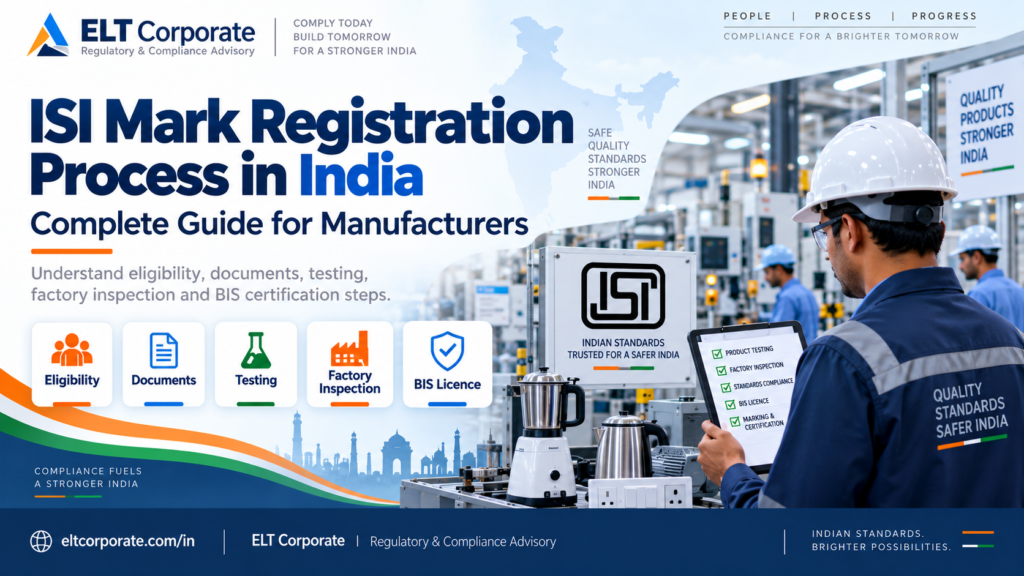
If you manufacture products in India, ensuring quality and meeting regulatory requirements is essential for building customer trust. For products covered under mandatory certification requirements, obtaining the appropriate BIS licence is also a legal necessity.
The ISI Mark Registration Process in India helps manufacturers demonstrate that their products meet the relevant Indian Standards prescribed by the Bureau of Indian Standards (BIS).
From electrical appliances and building materials to industrial products, ISI certification plays an important role in ensuring product quality, safety, and reliability.
However, many manufacturers find the certification process confusing. Questions about required documents, factory inspections, product testing, government fees, and approval timelines can make the procedure appear complicated.
This comprehensive guide explains the ISI Mark Registration Process in India, including eligibility, documents, costs, certification steps, and important compliance requirements for 2026.
What Is ISI Mark Certification in India?
ISI Mark Certification is a product conformity certification administered by the Bureau of Indian Standards, India’s national standards body.
The ISI Mark indicates that a product conforms to the applicable Indian Standard and is manufactured under a valid BIS licence.
Certification for using the ISI Mark is generally granted by the ISI Mark Registration Process in India under Scheme I of the BIS (Conformity Assessment) Regulations, 2018.
The certification process evaluates the manufacturer’s production facilities, quality control arrangements, testing capabilities, and product conformity.
For consumers, the ISI Mark provides assurance of compliance with recognized standards. For manufacturers, it demonstrates a commitment to maintaining consistent product quality.
Why Is ISI Mark Registration Important?
Obtaining BIS ISI Certification provides several advantages to manufacturers operating in the Indian market.
1. Legal Compliance
Products covered under ISI Mark Registration Process in India applicable mandatory Quality Control Orders (QCOs), must comply with the prescribed certification requirements. Manufacturers should obtain the necessary licence before undertaking regulated activities.
2. Consumer Confidence
An ISI mark helps customers identify products manufactured according to applicable Indian standards.
3. Improved Product Quality
The certification process encourages ISI Mark Registration Process in India manufacturers to maintain consistent production controls, testing procedures, and quality management practices.
4. Better Market Opportunities
ISI-certified products may receive greater acceptance from distributors, institutional buyers and customers who prioritize recognized quality standards.
5. Reduced Compliance Risks
Maintaining a valid BIS licence helps manufacturers address applicable regulatory obligations and avoid unauthorised use of the Standard Mark.
Is ISI Mark Registration Mandatory in India?
BIS product certification is generally voluntary unless a product is covered by a mandatory quality control order or another applicable legal requirement.
ISI Mark Registration Process in India is not mandatory for every manufactured product.
The Central Government introduces QCOs for specified product categories to address concerns involving safety, quality, public interest, and consumer protection.
Manufacturers and importers should verify whether their products fall under a currently applicable QCO.
Examples of product groups that may contain items requiring Scheme-I certification include:
- Cement and specified construction materials.
- Certain steel products and industrial materials.
- Specified electrical appliances.
- Certain electrical accessories and equipment.
- Selected automotive components.
- Products covered by specific mandatory certification orders.
Important: The applicable product, Indian Standard, certification scheme, QCO commencement date, and any exemption must be checked individually. Not every product in these categories requires an ISI Mark.
Who Can Apply for ISI Mark Registration in India?
The ISI Mark Registration Process in India is primarily intended for manufacturers seeking permission to use the BIS Standard Mark on their products.
Indian Manufacturers
Indian manufacturers may apply for BIS certification for products covered under the applicable Scheme-I requirements.
A manufacturing unit should have suitable production infrastructure, quality control arrangements, and testing facilities as prescribed by the relevant Indian Standard and BIS guidelines.
Foreign Manufacturers
Foreign manufacturers intending to supply ISI Mark Registration Process in India regulated products to India may obtain certification through the Foreign Manufacturers Certification Scheme (FMCS), where applicable.
They must satisfy the relevant BIS requirements, including the appointment of an Authorised Indian Representative (AIR), where required.
MSME Manufacturers
Micro, small, and medium enterprises can also apply for ISI certification.
Eligible MSME manufacturers may benefit from applicable fee concessions or testing-related facilitation measures, subject to BIS rules.
Step-by-Step ISI Mark Registration Process in India
Understanding the ISI Mark Registration Process in India helps manufacturers prepare documentation, avoid common errors, and manage certification requirements efficiently.
Step 1: Identify the Applicable Indian Standard
The first step is determining which Indian Standard applies to the product.
Manufacturers should verify the ISI Mark Registration Process in India applicable varieties, testing requirements, and any mandatory QCO.
Incorrect classification or selection of the Indian Standard can result in delays and additional testing.
Step 2: Prepare Manufacturing and Technical Documents
Before applying, the manufacturer should collect relevant business and factory documents.
These may include manufacturing process details, production machinery, quality control arrangements, testing equipment, product specifications, and calibration records.
The exact documentation varies depending on the product and certification requirements.
Step 3: Establish Product Testing Facilities
Manufacturers must demonstrate appropriate ISI Mark Registration Process in India testing capabilities and quality control arrangements as required by the applicable Indian Standard and BIS product manual.
This may involve setting up an in-house laboratory, obtaining necessary testing instruments, and maintaining valid calibration records.
Testing arrangements must comply with the relevant BIS guidelines.
Step 4: Conduct Product Testing
Product testing is an important part of the ISI certification process.
Depending on the applicable certification route, samples may be tested at a BIS-recognized or permitted laboratory, at the manufacturing premises, or through a combination of testing arrangements.
Testing requirements may involve:
- Electrical safety and performance.
- Mechanical strength and durability.
- Chemical composition.
- Dimensional accuracy.
- Product-specific quality parameters.
The test report helps establish whether the product conforms to the relevant Indian Standard.
Step 5: Submit the BIS Application Online
Manufacturers must submit the ISI Mark Registration Process in India application through the official BIS Manakonline portal.
The application generally includes business details, manufacturing location, product specifications, relevant IS number, supporting documents, and applicable fees.
The sequence of testing and application submission depends on the certification route selected under Scheme-I.
Step 6: BIS Factory Inspection
BIS evaluates the manufacturing unit to assess its readiness for certification.
During factory inspection, officials may examine:
- Manufacturing machinery and production facilities.
- Process controls and production records.
- Testing instruments and calibration certificates.
- Quality control procedures.
- Product conformity and sample testing arrangements.
- Compliance with the applicable Scheme of Inspection and Testing.
Any deficiencies identified during assessment must be addressed in accordance with BIS requirements.
Step 7: Grant of BIS ISI Licence
After successful ISI Mark Registration Process in India assessment of the manufacturing infrastructure, testing capabilities, documentation, and product conformity, BIS may grant the certification licence.
The license authorizes the manufacturer to use the ISI Mark on products covered within its approved scope.
Manufacturers must follow the applicable marking requirements and licence conditions.
Documents Required for ISI Mark Registration in India
The following documents are commonly relevant to the ISI Mark Registration Process in India.
| Document Category | Required Documents |
| Business Documents | Company registration, PAN, GST, and relevant business details |
| Factory Documents | Manufacturing address proof, factory layout, and manufacturing process flowchart |
| Machinery Details | List of production machinery and equipment |
| Product Documents | Product specifications, drawings, and relevant Indian Standard |
| Quality Control | Testing equipment details, calibration certificates, and quality control records |
| Testing Documents | Applicable product test reports |
| Authorization | Authorised signatory details and supporting authorisation |
Additional documents may be required based on the product category, BIS application route, and manufacturing arrangements.
ISI Mark Registration Fees in India
The cost of ISI Mark Registration Process in India depends on the product, applicable Indian Standard, laboratory testing requirements and manufacturing arrangements.
Common fee components include:
| Fee Component | Description |
| Application Fee | Payable when submitting the BIS application |
| Inspection Fee | Charges associated with factory assessment |
| Testing Fee | Depends on laboratory and product testing requirements |
| Annual Licence Fee | Applicable fee for maintaining the BIS licence |
| Marking Fee | Product-specific fee prescribed by BIS |
| Professional Fee | Consultancy charges, where services are engaged |
BIS’s published Scheme-I FAQ specifies an application fee of ₹1,000, an inspection fee of ₹7,000 per man-day, and an annual licence fee of ₹1,000, along with applicable product-specific marking fees. ISI Mark Registration Process in India Manufacturers should verify the latest fee schedule, applicable taxes, and concessions before payment.
The overall certification expense cannot be determined accurately without assessing the relevant product and standard.
How Long Does the ISI Mark Registration Process Take?
The time required for ISI Mark Registration in India depends on the selected certification procedure, product testing requirements, and readiness of the manufacturing facility.
BIS provides two routes under Scheme-I. Its published guidance indicates different average processing periods for these routes.
Actual approval times can vary based on:
- Completeness of the application.
- Availability of laboratory testing.
- Product conformity with Indian Standards.
- Factory inspection scheduling.
- Response to BIS queries.
- Additional compliance requirements.
Manufacturers should avoid relying on a guaranteed approval date without assessing the product-specific requirements.
ISI Mark Licence Validity and Renewal
Obtaining an ISI licence is not the end of the manufacturer’s compliance responsibilities.
The licence is subject to applicable validity and renewal conditions prescribed by BIS.
To maintain certification, manufacturers should ISI Mark Registration Process in India ensure continuous product conformity, maintain testing and inspection records, comply with marking requirements, and cooperate with BIS surveillance activities.
Renewal generally involves submitting the prescribed request, required information, and applicable fees.
Any significant changes affecting the product, manufacturing arrangements, or licence scope should be addressed in accordance with BIS procedures.
Common Mistakes During ISI Mark Registration
Manufacturers sometimes face avoidable delays ISI Mark Registration Process in India because they begin the application without adequate preparation.
Incorrect Indian Standard Selection
Choosing an unsuitable IS number or failing to identify the relevant product variety may lead to an incorrect application scope.
Incomplete Documentation
Missing technical documents, machinery information, or testing records may delay application processing.
Inadequate Testing Facilities
Manufacturers should ensure that ISI Mark Registration Process in India prescribed testing equipment and quality control arrangements are available before assessment.
Product Testing Failures
Products that do not meet the applicable Indian standard may require corrective measures and further testing.
Poor Factory Inspection Readiness
Unorganized records, inadequate calibration, and incomplete quality ISI Mark Registration Process in India procedures may result in deficiencies.
Practical Tip: Conducting an internal compliance assessment before submitting the application can help identify gaps and reduce avoidable delays.
Difference Between BIS Certification and ISI Mark
Although the terms “BIS Certification” and “ISI Mark Certification” are often used interchangeably, they are not identical.
| BIS Certification | ISI Mark |
| Broader conformity assessment framework administered by BIS | Standard Mark associated with Scheme-I product certification |
| Includes different certification and registration schemes | Used for products certified under the applicable ISI Mark Scheme |
| Requirements depend on the applicable scheme. | Demonstrates conformity to the relevant Indian Standard under a BIS licence |
Businesses should identify the appropriate BIS scheme before beginning their certification application.
How ELT Corporate Can Help with ISI Mark Registration
The ISI Mark Registration Process in India involves technical documentation, regulatory assessment, product testing, and coordination with BIS.
At ELT Corporate Private Limited, we assist manufacturers in understanding and managing applicable BIS certification requirements.
Our support services include:
- Identifying the applicable Indian Standard and certification scheme.
- Reviewing mandatory QCO applicability.
- Preparing BIS application documentation.
- Assessing manufacturing and testing readiness.
- Coordinating product testing requirements.
- Supporting factory inspection preparation.
- Assisting with responses to BIS queries.
- Providing guidance on licence renewal and ongoing compliance.
Whether you are an Indian manufacturer or a foreign business planning to enter the Indian market, understanding the correct certification route can help you avoid unnecessary compliance difficulties.
Explore our BIS ISI Certification Services or visit ELT Corporate for professional assistance.
Conclusion
The ISI Mark Registration Process in India is an important part of product quality assurance and regulatory compliance for manufacturers.
From identifying the correct Indian Standard to preparing technical documentation, completing product testing and undergoing factory inspection, every stage contributes to establishing product conformity.
Manufacturers should verify the latest BIS requirements, maintain suitable quality control systems, and complete the applicable certification formalities before using the ISI Mark.
With proper preparation and professional guidance, businesses can manage BIS certification requirements efficiently while improving product quality and market credibility.
Frequently Asked Questions
Q1. What is the ISI Mark Registration Process in India?
It is the BIS certification procedure through which eligible manufacturers obtain a licence to use the ISI Mark on products conforming to applicable Indian Standards.
Q2. Is ISI Mark Registration mandatory?
ISI certification is mandatory for specified products covered by applicable quality control orders. For other products, certification may be voluntary.
Q3. Who issues the ISI Mark Certificate?
The Bureau of Indian Standards (BIS) grants the licence permitting use of the ISI Standard Mark.
Q4. What documents are required for ISI Certification?
Common documents include company registration, manufacturing details, product specifications, testing records, and quality control documentation.
Q5. How much does ISI Mark Registration cost?
Costs depend on BIS fees, product testing, factory inspection, applicable marking fees, and any professional assistance required.