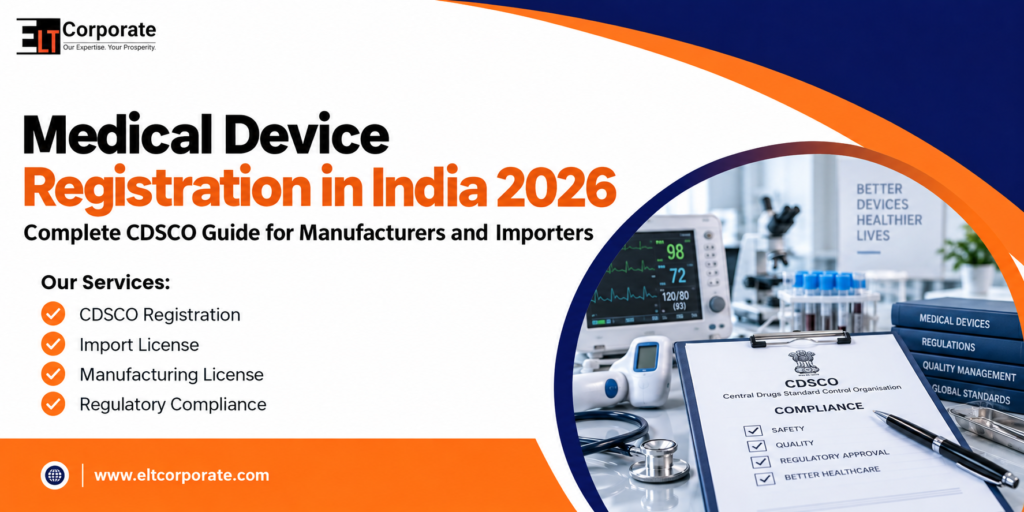
India’s medical device sector continues to expand very rapidly, offering great opportunities for both local and foreign medical device manufacturers. However, before a controlled medical device can be manufactured, imported, or marketed in India, it is important for companies to be aware of the regulatory requirements that apply under the Medical Devices Rules, 2017.
Regulations related to the registration of medical devices in India are mainly overseen by the Central Drugs Standard Control Organisation (CDSCO), Ministry of Health and Family Welfare, Government of India, along with State Licensing Authorities for certain manufacturing processes.
Whether you are a local manufacturer, foreign manufacturer, importer, startup, healthcare technology company, or authorized local agent, knowledge about the Medical Device Registration in India procedure is mandatory prior to placing your medical device on the Indian market.
This comprehensive 2026 guide covers medical device classification, CDSCO licensing, manufacturing licenses, import licenses, documentation, application forms, regulatory authorities, and all procedures necessary for medical device registration in India.
What is Medical Device Registration in India?
Medical Device Registration in India is defined as the regulatory process of registering, licensing, or other types of authorization of a medical device for manufacture, import, sale, or distribution in India in compliance
Some of the factors that determine the requirements include:
- Purpose of use of the medical device
- Classification of risk
- If it is manufactured locally or imported to India
- Sterility status
- If it is a measuring device
- If there is a predicate device
- If it is an investigational or new medical device
- Manufacturing site
- Product standards applicable
It is therefore important to determine the regulatory process first before undertaking a Medical Device Registration in India application.
Who Is The Regulatory Body For Medical Device Registration In India?
The leading body regulating medical device registration in India is the Central Drugs Standard Control Organisation (CDSCO).
CDSCO works under the supervision of the Directorate General of Health Services, Ministry of Health and Family Welfare, Government of India.
Regulatory roles can be distributed among the Central Licensing Authority and State Licensing Authority based on the nature and classification of the medical device.
For instance, CDSCO ensures that the application for manufacturing of Class C and Class D medical devices is made in Form MD-7 and licenses are granted in Form MD-9, whereas medical device import license applications shall be in Form MD-14, granting Form MD-15.
Medical Device Registration in India under Medical Devices Rules, 2017
The major regulation governing medical device registration in India is the Medical Devices Rules, 2017.
The rules make provisions for the following:
- Classification of medical devices
- Manufacturing licenses
- Import licenses
- Quality management system
- Clinical Investigation
- Performance Evaluation
- Labeling
- Testing
- Registration of Notified Bodies
- Sales and Distribution
- Post-Market Regulatory Compliance
Firms that want to operate within the Indian medical device industry must first classify their devices according to the MDR 2017 and then decide on the right CDSCO route of application.
Risk Classification for Medical Device Registration in India
Among the important things in medical device registration in India is the right risk classification of your medical device.
According to the Medical Devices Rules, 2017, medical devices can be classified under four risk categories:
| Medical Device Class | Risk Level |
| Class A | Low Risk |
| Class B | Low-Moderate Risk |
| Class C | Moderate-High Risk |
| Class D | High Risk |
CDSCO adopts this risk-based classification system of four tiers under the First Schedule of MDR 2017.
Classification of the device will be based on several parameters, including use of the device, contact duration, invasiveness, activeness of the device, and risk associated with use of the device.
Classification of the device is important because licensing authority, documentation, inspection process, regulatory review, and application process for Medical Device Registration in India may differ from one device category to another.
Medical Device Registration in India for Class A Devices
Class A medical devices are mostly considered the safest category.
However, there is a significant difference between:
1. Class A non-sterile and non-measuring device
and
2. Other Class A devices
The amended Medical Devices Rules exempt the Class A medical devices that are non-sterile and non-measuring from the usual licensing requirements.
Rather than having a manufacturing and import license, the manufacturer and importer shall register for a registration number using the CDSCO online medical device system as per Chapter IIIB of MDR 2017.
CDSCO has further confirmed that the government fee is yet to be levied for such a registration number.
Consequently, it should not be presumed that all Class A devices follow the Medical Device Registration in India procedure in the same way.
Medical Device Registration in India for Class B Devices
Class B medical devices are categorized as low- to moderate-risk medical devices.
For domestic manufacturing, the application is normally made to the respective state licensing authority.
In the case of domestic manufacture, the application is normally made to the relevant State Licensing Authority.
It is necessary for the manufacturer to define the relevant quality management and technical documentation and manufacture according to the requirements as specified under MDR 2017.
Depending on the mode of regulation and nature of the product, an evaluation from a Notified Body, if required, can also be considered for Class A and Class B manufacturing establishments.
Classification should always be done before applying for medical device registration in India.
Class C Medical Device Registration in India
Class C medical devices are medium-risk to high-risk medical devices and therefore undergo more regulation.
Manufacturing of Class C medical devices in India involves:
- An application being made through Form MD-7
- Manufacturing license issuance through Form MD-9
The Central Licensing Authority is responsible for the manufacturing licensing process for Class C and D devices.
Examples of devices that fall under Class C vary depending on their intended use.
This is because classification is done based on the intended use of the device. Therefore, a manufacturer should not classify his medical device registration in India by comparing the commercial name of his product with that of other devices.
Medical Device Registration in India – Class D Medical Devices
Class D denotes the highest-risk class within India’s medical devices regulation scheme.
Such devices could be those that are life-sustaining, implantable, cardiovascular, or any other high-risk devices based on the intended use and the CDSCO classification.
In case of domestic manufacture:
Application: MD-7 form
License: MD-9 form
Class D Medical Device Registration in India often entails detailed technical, risk management, and quality systems documentation, as well as testing.
Registration of Medical Devices in India for Local Manufacturing
Indian companies wishing to manufacture medical device products should obtain the necessary permission depending on the product classification.
The general manufacturing procedure is as follows:
| Device Category | Application | License/Registration |
| Class A: non-sterile & non-measuring | Online registration | System-generated registration number |
| Class A/B requiring a manufacturing license | MD-3 | MD-5 |
| Class C/D | MD-7 | MD-9 |
The specific route must be assessed based on the current classification and regulations of CDSCO.
As regards applications for Class C and Class D medical devices, the CDSCO clearly stipulates MD-7 applications and MD-9 licenses for these devices.
Indian Medical Device Registration for Foreign Manufacturers
A foreign manufacturer generally does not go through an Indian medical device import license procedure without an applicant in India who qualifies.
Where it comes to applications for imported medical devices, the applications are submitted via an authorized Indian party in accordance with the rules laid down by MDR 2017.
The Indian party serves as the regulatory point of contact between the CDSCO and the foreign manufacturing facility and the products included in the application.
Thus, foreign manufacturers wishing to register their medical devices in India need to choose an appropriate Indian authorized party carefully.
Medical Device Registration in India: Import Licence
As per medical device registration in India for the import of medical devices that have been produced outside of India, an import licence would be required except under certain exemptions or alternative registration processes.
The usual CDSCO process would be
Form of Application: MD-14
Import Licence: MD-15
It has been mentioned explicitly by CDSCO that for obtaining the import licence, an application must be made through Form MD-14 on the online portal for obtaining the license in Form MD-15.
The license in Form MD-15 includes information about the manufacturer, manufacturing facility, and the medical devices that can be imported to India.
Steps for Medical Device Registration in India
Some of the steps involved in registering a medical device in India are as follows.
Step 1: Identify whether the product is a medical device.
It involves assessing the intended use of the product and its classification according to the regulatory definition.
Some of the products that may qualify as medical devices on the basis of their intended use include hardware devices, diagnostics, implants, software, etc.
Step 2: Determine the Classification of the Product
Decide whether the product falls into the following categories:
- Class A
- Class B
- Class C
- Class D
Also review CDSCO classification and classification rules in the First Schedule.
Step 3: Establish Regulatory Pathway
Determine whether the application involves
- Domestic manufacture
- Import
- Loan license
- Testing license
- Clinical trial
- Investigational/new medical device
Class A non-sterile and non-measurement registration
Step 4: Compile the Documentation
Prepare the Device Master File, manufacturing documentation, testing documentation, QMS documentation, and other documentation related to the medical device.
Step 5: Submit the CDSCO Application
File the appropriate application in the CDSCO online medical device portal.
Step 6: Regulatory Review
The regulatory authority reviews the application with its accompanying documents.
Deficiency letters or inquiries may be raised when there is a need for further information.
Step 7: Inspection or Audit, if Any
Depending on the type of license and the class of the device, an inspection/audit may be necessary.
Step 8: Answering of Regulatory Inquiries
A scientifically/technically sound reply to regulatory inquiries shall be provided by the applicant.
Step 9: Issuance of License Number/Registration
After it is satisfied that all regulatory criteria have been complied with, the license/permission number or the registration number may be issued.
Medical Device Registration in India and ISO 13485
ISO 13485 is a globally recognized standard on quality management systems tailored especially for medical device companies.
The scope includes, but is not limited to:
- Quality management
- Design & Development
- Production Controls
- Supplier Management
- Processes based on risk analysis
- Traceability
- Complaints
- Corrective and Preventive Actions
Nevertheless, one must understand the difference between having an adequate quality management system and having the ISO 13485 certificate and not think that this would automatically mean CDSCO approval.
The published FAQ by CDSCO states clearly that an ISO 13485:2016 certificate itself is not a mandatory requirement for getting a manufacturing license in accordance with MDR 2017.
Therefore, businesses should consider the full quality management system requirements for their individual Medical Device Registration in India application.
Documentation for Medical Device Registration in India
Medical Device Registration in India will require the following documents, subject to the applicant’s type of activity and classification of the device.
Typical documents can consist of:
- Cover letter
- Application form
- Challan for government fees, where applicable
- Information about the manufacturer
- Information about the manufacturing place
- Information about the device
- Intended use
- Classification rationale
Exact documents to prepare for medical device registration in India should be prepared taking into consideration the product and CDSCO requirements rather than the above-mentioned general checklist.
Registration of Medical Devices in India for Software that Constitutes a Medical Device
However, software may also be classified as a medical device in India if the intended purpose is included in the definition of a medical device as per the applicable classification rules.
Some examples include the following:
- Diagnostic software
- Clinical decision support software
- Image analysis software
- AI-enabled diagnostic software
- Software as a Medical Device (SaMD)
In 2026, CDSCO published exclusive guidance on medical device software as part of MDR 2017 to emphasize the need for software-specific intended use evaluation.
Software developers intending to register their medical device in India need to consider the following aspects related to software.
Medical Device Registration in India for Novel Medical Devices
A novel medical device for which no predicate exists may require yet another regulatory procedure before routine manufacturing or importation.
For instance, CDSCO’s 2026 medical device software guidance suggests the use of the Form MD-26 application as a means to seek permission to import or manufacture and sell or distribute a novel medical device without a predicate device in relevant cases.
Thus, it is recommended to find out whether your medical device is either a conventional medical device that has a predicate or a new/investigational medical device before starting the regular Medical Device Registration in India procedure.
Labelling Requirements for Medical Device Registration in India
Medical devices offered on the Indian market shall satisfy the necessary labelling requirements laid down under MDR 2017.
The information required by the applicable labelling requirements may include but is not limited to the following:
- Name of the medical device
- Name and address of the manufacturer
- Name of the importer in case of imported medical devices
- Information regarding manufacturing
- Batch/lot number
- Serial number, if any
- Date of manufacturing
How ELT Corporate Can Assist with Medical Device Registration in India?
Registration of medical devices in India can become challenging due to several factors, like several products, manufacturing facilities, different classifications, and technicalities.
ELT Corporate offers regulatory consulting services for the registration of medical devices for manufacturers, importers, foreign manufacturers, start-ups, and health care companies.
Some of the services offered by our firm related to medical device regulation include
- Medical device regulatory assessment
- Product classification
- CDSCO application strategy
- MD-5 manufacturing license assistance
- MD-9 manufacturing license assistance
- MD-15 import license assistance
- Class A non-sterile and non-measuring registration
- Device Master File preparation
- Medical device post-approval regulation assistance
Proper planning for medical device registration in India can help manufacturers and importers save time and avoid documentation mistakes.
Conclusion
India is one of the promising countries for medical device manufacturers, importers, technology companies, and other healthcare businesses operating internationally. However, regulatory compliance should be ensured before introducing any products in India.
In order to register medical devices in India, it is necessary to thoroughly evaluate such aspects as device class, intended use, pathway of manufacturing or importing, technical documentation, quality management system, testing, labeling and necessary applications to the CDSCO.
Different regulatory pathways apply to Class A, B, C, and D medical devices, whereas a particular registration pathway applies to Class A non-sterile and non-measuring medical devices. Pathways MD-14/MD-15 apply to imported devices, while the domestic manufacturing license depends on the class of a certain device.
Since CDSCO classifications, guidance documents, and regulations may change, it is recommended that manufacturers and importers of medical devices in India be sure of the latest requirements for medical device registration.
For professional assistance with medical device registration in India, you may contact ELT Corporate.
Frequently Asked Questions
Q1. What is medical device registration in India?
It is the CDSCO regulatory process required to manufacture, import, or market regulated medical devices in India.
Q2. Who regulates medical device registration in India?
CDSCO and the relevant State Licensing Authorities regulate medical devices in India.
Q3. How are medical devices classified in India?
Medical devices are classified into Class A, B, C, and D based on risk.
Q4. Which form is used for a medical device import licence?
Form MD-14 is used to apply, and the import licence is issued in Form MD-15.
Q5. Which licence is required for manufacturing Class C and D devices?
The application is filed in Form MD-7, and the licence is issued in Form MD-9.
Q6. Do Class A non-sterile and non-measuring device requires a licence?
They generally require online registration instead of the regular licensing process.