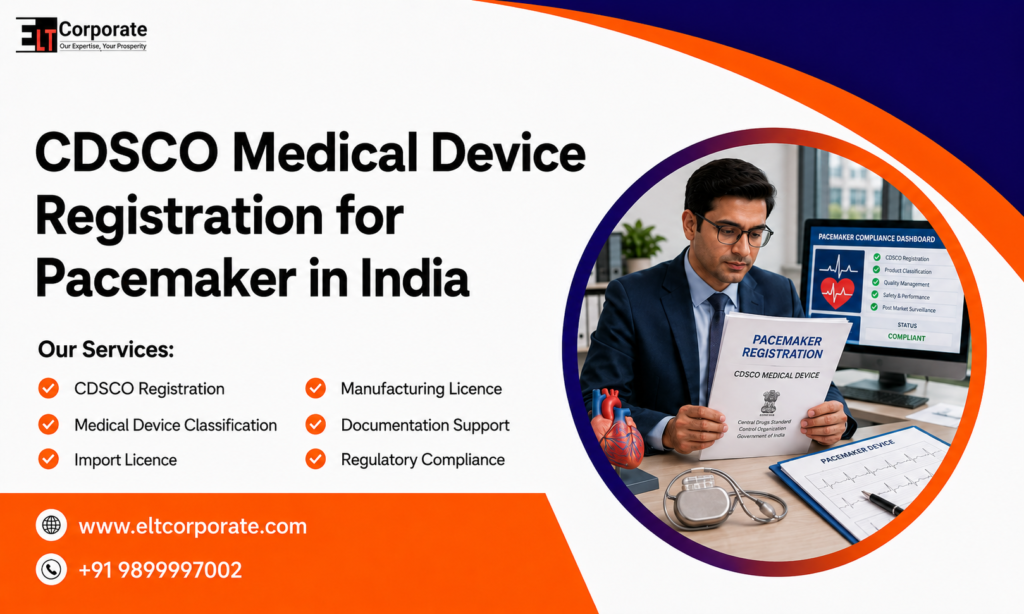
Pacemakers are critical implantable medical devices used to regulate abnormal heart rhythms by generating electrical impulses that stimulate the heart. Due to their implantable nature and direct role in maintaining cardiac function, pacemakers are treated as high-risk medical devices in India.
The manufacture, import and sale of pacemakers in India are regulated by the Central Drugs Standard Control Organisation (CDSCO) under the Medical Devices Rules, 2017.
What is a Pacemaker?
A pacemaker is an electronic medical device generally implanted inside the body to help maintain an appropriate heart rhythm. It generates electrical impulses that stimulate the heart when the natural electrical activity of the heart is inadequate or irregular.
Pacemaker systems may include a pulse generator, leads, electrodes, programmers and other accessories. However, these components should not automatically be assumed to have the same CDSCO classification.
CDSCO Classification of Pacemaker
CDSCO specifically lists “Implantable cardiac pacemaker including accessories” as Class D. Class D represents the highest-risk category of medical devices under the Indian regulatory framework.
At the same time, certain related products may have a different classification. For example, the CDSCO classification document separately identifies a pacemaker lead adaptor as Class C and a permanent pacemaker electrode as Class C. Therefore, every component and accessory should be assessed according to its exact intended use before filing the application.
Who Regulates Pacemaker Registration in India?
As a Class D medical device, a pacemaker falls under the jurisdiction of the Central Licensing Authority (CLA).
For commercialisation of Class C and Class D devices, the Central Licensing Authority handles both manufacturing licences and import licences under the Medical Devices Rules, 2017.
CDSCO Import Licence for Pacemaker
A foreign manufacturer that wants to import and market a pacemaker in India must obtain a CDSCO import licence.
The applicable route is:
Form MD-14 → Form MD-15
The application in Form MD-14 is submitted by an eligible Indian Authorised Agent to the Central Licensing Authority. After review and approval, the import licence is issued in Form MD-15. Rule 34 of the Medical Devices Rules specifically requires the authorised agent to apply through the identified online portal.
CDSCO Manufacturing Licence for Pacemaker
A manufacturer intending to manufacture a Class D pacemaker in India generally follows the Class C and Class D manufacturing licence route:
Form MD-7 → Form MD-9
The application is made to the Central Licensing Authority. CDSCO’s published regulatory pathway confirms Form MD-7 to Form MD-9 for commercial manufacture of Class C and Class D medical devices.
Documents Required for CDSCO Pacemaker Registration
The documentation requirement is substantial because a pacemaker is a high-risk implantable medical device. For an import licence application, the CDSCO checklist includes regulatory, quality and technical documents such as the following.
- Covering letter
- Form MD-14 application
- Government fee challan
- Power of Attorney in favour of the Indian Authorised Agent
- Wholesale/manufacturing licence or applicable registration of the Authorised Agent
- Constitution details of the Indian Authorised Agent
- Free Sale Certificate or Marketing Authorisation, as applicable
- Overseas manufacturing-site registration
- Latest regulatory inspection or audit report, where applicable
- Quality Management System certificate
- Declaration of Conformity
- Plant Master File
- Device Master File
- Device description and intended use
- Product specifications and details of variants/accessories
- Device grouping justification
- Predicate/substantial-equivalence information, where applicable
- Labels and Instructions for Use
- Device design and manufacturing information
- Essential Principles Checklist
- Risk analysis and risk-control documents
- Verification and validation reports
- Biocompatibility data, where applicable
- Sterilisation validation, where applicable
- Software verification and validation, where applicable
- Stability or shelf-life data, where applicable
- Clinical evidence
- Post-Market Surveillance information
- Batch-release or Certificate of Analysis documents, as applicable
CDSCO’s current import checklist expressly covers items such as substantial equivalence, labelling, risk analysis, verification and validation, sterilisation, software validation, clinical evidence and post-market surveillance.
Step-by-Step CDSCO Registration Process for Pacemaker
Step 1: Confirm the Device and its Classification
The first step is to identify exactly what is being registered. The pulse generator, pacemaker lead, electrode, adaptor and other accessories may not necessarily carry the same classification.
The intended use, technology and CDSCO classification list should therefore be reviewed before preparing the application.
Step 2: Determine the Correct Licensing Route
For an imported pacemaker, the regular commercial licensing route is MD-14 to MD-15.
For a pacemaker manufactured in India, the Class D manufacturing route is generally MD-7 to MD-9.
Step 3: Appoint an Indian Authorised Agent for Import
In the case of a foreign manufacturer, an eligible Indian Authorised Agent must be appointed.
The Medical Devices Rules require the authorised agent to hold the applicable manufacturing or wholesale licence and submit the import application to the Central Licensing Authority.
Step 4: Prepare the Technical Dossier
The applicant must prepare the Plant Master File, Device Master File and supporting technical documentation.
For a pacemaker, special attention should be given to device design, risk management, electrical and performance validation, software where applicable, biocompatibility, sterilisation, clinical evidence and post-market information.
Step 5: Submit the Application to CDSCO
The appropriate application is submitted through the medical-device online regulatory system along with the prescribed government fee and supporting documents.
CDSCO’s published regulatory pathway specifies online submission for medical-device applications.
Step 6: CDSCO Technical Review
CDSCO reviews the regulatory and technical documentation submitted with the application.
For import applications, the Central Licensing Authority may also cause an inspection of the overseas manufacturing site where considered necessary.
Step 7: Respond to CDSCO Queries
If CDSCO identifies deficiencies or requires clarification, the applicant must submit an appropriate response with revised documents, supporting evidence or justification.
Clear consistency between the application, Device Master File, labels, IFU, intended use, certificates and technical reports is important during this stage.
Step 8: Grant of CDSCO Licence
Once the authority is satisfied with the application and regulatory requirements, the relevant licence may be issued.
For an imported pacemaker, the approval is issued in Form MD-15. The Medical Devices Rules provide that the Central Licensing Authority may grant or reject an import application within the prescribed regulatory period after examining the documents and inspection report, where an inspection has been conducted.
What If the Pacemaker Does Not Have a Predicate Device?
A pacemaker involving new technology or having no predicate may fall within the provisions applicable to an investigational medical device.
In such cases, the applicant may have to obtain permission for clinical investigation and/or prior permission for the investigational medical device before proceeding with the normal commercial licence. CDSCO’s regulatory pathway identifies MD-22 to MD-23 for clinical investigation and MD-26 to MD-27 for permission relating to an investigational medical device.
Therefore, predicate assessment should be completed at an early stage of the registration process.
Common Reasons for Delay in Pacemaker Registration
Pacemaker applications may face regulatory queries when there are inconsistencies or gaps in the technical dossier. Common issues include incomplete Device Master Files, inadequate clinical evidence, incorrect classification, missing validation reports, insufficient risk-management documentation, differences between the intended use and IFU, or incomplete information relating to accessories and models.
A detailed regulatory review before filing can help reduce avoidable CDSCO queries.
Conclusion
CDSCO Medical Device Registration for Pacemaker requires extensive regulatory and technical preparation because implantable cardiac pacemakers are classified as high-risk Class D medical devices in India.
Foreign manufacturers generally need an MD-15 Import Licence through an MD-14 application, while Indian Class D manufacturers generally follow the MD-7 to MD-9 manufacturing licence route.