
Importing goods into India involves several legal, commercial, and customs-related formalities. Whether a business imports raw materials, machinery, electronics, medical devices, cosmetics, or finished products, maintaining the correct documentation is essential for smooth customs clearance and regulatory compliance.
Understanding the documents required for importing goods into India helps businesses avoid shipment delays, unnecessary penalties, additional costs, and customs-related complications.
India’s import procedures are governed by various regulations, including the Foreign Trade Policy, the Customs Act, 1962, applicable DGFT notifications, and product-specific regulatory requirements. Importers must ensure that their documents are accurate, complete, and consistent before shipping goods to India.
In this guide, we will explain the important import documents, their purposes, the customs clearance process, and additional documents required for importing goods into India approvals that businesses may require when importing products into India.
Why Is Import Documentation Important in India?
Import documentation plays an important role in international trade. Indian customs authorities use these documents required for importing goods into India to verify the description, quantity, value, origin, and classification of imported goods.
Proper documentation helps importers:
- Complete customs clearance smoothly.
- Establish the correct assessable value of imported goods.
- Calculate applicable customs duties and taxes.
- Verify compliance with Indian import regulations.
- Avoid unnecessary shipment detention.
- Maintain proper financial and commercial records.
- Demonstrate compliance during regulatory inspections.
Businesses that understand the Documents Required for Importing Goods into India can prepare their shipments more efficiently and reduce the risk of documentation errors.
List of Documents Required for Importing Goods into India
The documentation requirements may vary depending on the documents required for importing goods into India nature of the products, the country of origin, applicable customs procedures, and regulatory requirements.
However, the following are some of the major documents generally required for commercial imports.
1. Import Export Code (IEC)
The Import Export Code (IEC) is a 10-digit identification number issued by the Directorate General of Foreign Trade (DGFT).
It is generally mandatory for businesses’ documents required for importing goods into India involved in importing goods into India, subject to applicable exemptions.
Purpose of IEC:
- Identifies the importer in international trade.
- Supports customs clearance procedures.
- Enables businesses to undertake import activities.
- Helps establish the importer’s identity in relevant trade transactions.
Importers should ensure that their IEC details are accurate and updated as required under DGFT regulations.
2. Commercial Invoice
A commercial invoice is an important document documents required for importing goods into India, issued by the overseas supplier or exporter to the Indian importer.
It contains details about the transaction and the value of imported goods.
Important information included in a Commercial Invoice:
- Name and address of the exporter.
- Name and address of the importer.
- Invoice number and date.
- Product description.
- Quantity and unit price.
- Total invoice value.
- Currency of transaction.
- Country of origin, where applicable.
- Payment terms.
- Delivery terms or Incoterms.
Customs authorities use the invoice to assess the value of imported goods and determine applicable duties.
3. Packing List
A packing list provides detailed documents required for importing goods into India, including information about how the goods are packed for transportation.
It helps customs authorities and logistics providers verify the physical contents of a shipment.
Details included in a packing list:
- Description of goods.
- Number of packages.
- Package identification.
- Gross weight and net weight.
- Dimensions of packages.
- Quantity of products.
- Packaging details.
The information in the packing list should match the commercial invoice and shipping documents.
4. Bill of Lading or Air Waybill
A Bill of Lading (B/L) or Air Waybill (AWB) is a document required for importing goods into India transportation document issued by the carrier or its authorized agent.
The document depends on the mode of transportation used.
Bill of Lading: Used for sea shipments and generally serves as evidence of the contract of carriage and receipt of goods.
Airway Bill: Used for air shipments and provides details about the transportation of goods.
These documents help identify the shipment, consignor, consignee, and transportation details.
5. Bill of Entry
The bill of entry is one of the most important documents required for importing goods into India and is an important document in the Indian import customs clearance process.
It is filed electronically through the Indian Customs Electronic Data Interchange system, generally by the importer or an authorized customs broker.
The document provides customs authorities with information about imported goods, including:
- Importer’s details.
- Description and classification of goods.
- Quantity and assessable value.
- Country of origin.
- Applicable customs duties.
- Supporting commercial and regulatory documents.
The Bill of Entry is a required document required for importing goods into India for the assessment and clearance of imported goods, subject to applicable customs procedures.
6. Certificate of Origin
A Certificate of Origin (COO) identifies the documents required for importing goods into India country in which the imported goods originate.
It may be required for customs purposes, trade policy compliance, or to claim preferential customs duty benefits under applicable Free Trade Agreements.
It generally contains:
- Exporter’s details.
- Importer’s details.
- Product description.
- Country of origin.
- Shipment information.
- Certification by an authorized issuing body, where applicable.
Importers should verify the documents required for importing goods into India, origin criteria, and documentary requirements before claiming preferential tariff benefits.
7. Insurance Certificate
An insurance certificate provides evidence of insurance coverage for goods during transportation.
It is relevant when the documents required for importing goods into India are insured under the applicable trade or transportation arrangement.
It may contain:
- Insured party’s details.
- Description of goods.
- Shipment details.
- Insured value.
- Coverage period.
- Insurance terms and conditions.
Insurance documents may also be relevant when determining the assessable value of imported goods under applicable documents required for importing goods into India customs valuation rules.
8. Purchase Order or Import Contract
A purchase order or import documents required for importing goods into India record the commercial agreement between the Indian importer and the foreign supplier.
It generally contains:
- Product specifications.
- Quantity and price.
- Payment conditions.
- Delivery schedule.
- Shipping terms.
- Quality requirements.
- Responsibilities of the buyer and seller.
This document helps establish the terms of the import transaction and may support customs valuation or other verification requirements.
9. Import License or Product-Specific Approval
Not all goods can be freely imported into India. Certain products may be restricted, regulated, or subject to documents required for importing goods into India, including specific licensing and approval requirements.
Depending on the product, importers may need approvals from authorities such as:
- Directorate General of Foreign Trade (DGFT).
- Central Drugs Standard Control Organisation (CDSCO).
- Bureau of Indian Standards (BIS).
- Food Safety and Standards Authority of India (FSSAI).
- Plant Quarantine authorities.
- Animal Quarantine authorities.
- Other relevant regulatory departments.
Importers should check the applicable ITC (HS) classification and current import policy before placing an order with an overseas supplier.
Additional Documents Required for Specific Imported Products
Apart from the general import documentation, certain products require additional regulatory certificates, registrations, or permissions.
1. Medical Devices
Businesses importing medical devices into India may require documents required for importing goods into Indiato apply for registration and import licensing under the Medical Devices Rules, 2017.
Depending on the product and regulatory classification, relevant documents may include:
- CDSCO import license, such as MD-15, where applicable.
- Free Sale Certificate, where required.
- ISO 13485 documentation, where applicable.
- Device details and product specifications.
- Manufacturing and quality-related documents.
- Authorized Indian agent documentation.
Importers should verify the applicable CDSCO requirements before shipping medical devices to India.
2. Cosmetics
Importing cosmetics into India requires compliance with the documents required for importing goods into India Cosmetics Rules, 2020.
Depending on the applicable requirements, businesses may need:
- CDSCO cosmetic import registration.
- Form COS-1 application.
- Form COS-2 registration certificate.
- Product ingredient details.
- Manufacturing and product information.
- Label and packaging details.
- Authorization documents for the Indian authorized agent.
Importers should complete the applicable regulatory formalities before commercial importation.
3. Food Products
Businesses importing food products into India documents required for importing goods into India must comply with the Food Safety and Standards Act and applicable FSSAI regulations.
Depending on the product, documentation may include:
- FSSAI Import License.
- Commercial Invoice.
- Packing List.
- Certificate of Analysis, where applicable.
- Health Certificate, where required.
- Product labels and ingredient details.
- Other supporting documents required by FSSAI.
4. Electronics and Electrical Products
Certain electronic and electrical products are subject to mandatory BIS certification or other applicable regulatory requirements.
Depending on the product category, importers may need:
- Applicable BIS registration or certification.
- Product test reports.
- Technical specifications.
- Manufacturer details.
- Applicable safety and conformity documents.
Importers should verify whether their products fall under a mandatory certification scheme before importing them.
Import Documentation Process in India: Step-by-Step Guide
Understanding the import documentation process documents required for importing goods into India helps businesses plan their shipments and avoid unnecessary delays.
Step 1: Identify the Product and ITC (HS) Code
The first step is identifying the correct classification of the imported product under the ITC (HS) classification system.
The classification helps documents required for importing goods into India determine the applicable import policy, customs duty, and regulatory requirements.
Step 2: Obtain Import Export Code
Businesses should obtain an IEC from DGFT, where required, before undertaking commercial import activities.
The importer should ensure that its business details and IEC information are correct.
Step 3: Check Import Policy and Product Approvals
Before placing an order, importers should documents required for importing goods into India verify whether the product is freely importable, restricted, prohibited or subject to specific conditions.
They should also identify applicable product-specific approvals and licenses.
Step 4: Collect Documents from the Overseas Supplier
The importer should coordinate with the foreign supplier to obtain the commercial invoice, packing list, bill of lading or airway bill and other documents required for importing goods into India, including applicable certificates.
All details should be checked for consistency.
Step 5: Arrange Customs Documentation
The importer or authorized customs broker prepares and files the Bill of Entry with the required supporting information through the customs electronic system.
Step 6: Customs Assessment and Duty Payment
Customs authorities assess the shipment based on the declared details and applicable regulations.
The importer must pay the applicable documents required for importing goods into India customs duties and taxes before clearance, subject to the relevant procedure.
Step 7: Customs Examination and Final Clearance
Customs authorities may examine the goods or verify supporting documents, depending on the applicable risk assessment and regulatory requirements.
Once the documents required for importing goods into India and the necessary formalities are completed and clearance is granted, the goods can be released for delivery.
Common Mistakes to Avoid During Import Documentation
Documentation mistakes can create documents required for importing goods into India complications during customs clearance and increase the overall cost of importing goods.
Some common mistakes include:
- Incorrect HS code classification.
- Mismatch between Commercial Invoice and Packing List.
- Incomplete or incorrect IEC details.
- Incorrect declaration of product value.
- Missing product-specific licenses.
- Incorrect country-of-origin information.
- Incomplete shipping documents.
- Failure to verify restricted import conditions.
- Incorrect product descriptions in customs declarations.
- Ignoring applicable labelling and packaging requirements.
Importers should review all documents before shipment dispatch to reduce the possibility of customs-related complications.
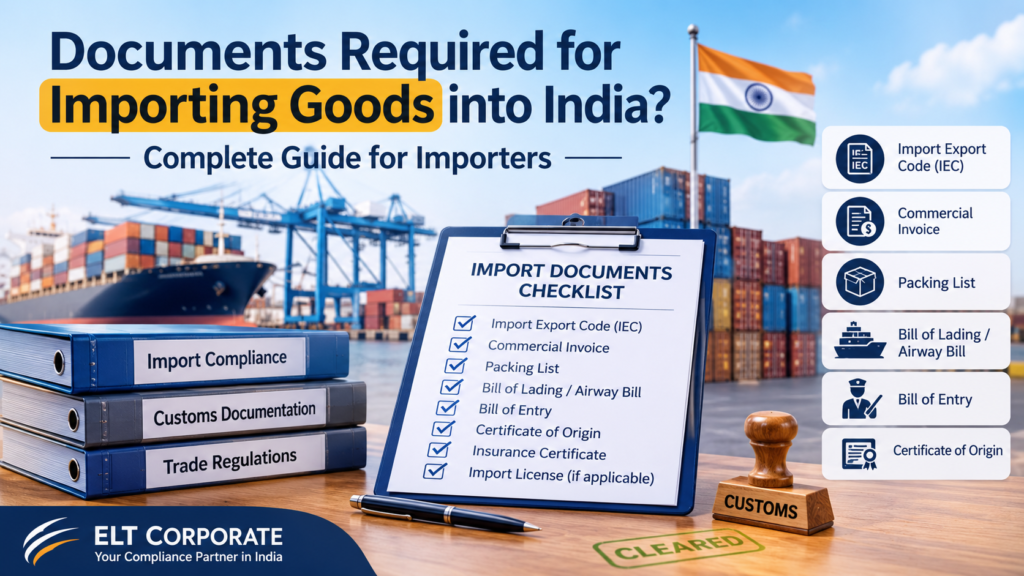
Checklist of Documents Required for Importing Goods into India
The following checklist can help documents required for importing goods into India businesses organize their import documentation.
| Document | General purpose |
| Import Export Code (IEC) | Importer identification |
| Commercial Invoice | Transaction and product value |
| Packing List | Package and quantity details |
| Bill of Lading / Air Waybill | Transportation details |
| Bill of Entry | Customs declaration |
| Certificate of Origin | Country of origin |
| Insurance Certificate | Shipment insurance, where applicable |
The above list is indicative. Actual documentation requirements depend on the imported product, applicable regulations, customs procedures, and nature of the transaction.
How ELT Corporate Can Help with Import Compliance in India
Importing goods into India documents required for importing goods into India requires coordination between suppliers, customs authorities, logistics providers, and regulatory departments.
Businesses must understand the documentation process and applicable product-specific regulations to avoid compliance-related complications.
ELT Corporate provides business, legal, and regulatory compliance consulting support to companies operating in India.
Our services can support businesses with:
- Import regulatory compliance guidance.
- Product-specific licensing and registration support.
- Documentation review and compliance assistance.
- CDSCO medical device and cosmetics regulatory support.
- BIS and Legal Metrology compliance guidance.
- EPR registration and compliance support.
- Business registration and corporate compliance consulting.
Whether you are a new importer or an established international business, understanding the Documents Required for Importing Goods into India is an important step towards maintaining regulatory compliance.
Contact ELT Corporate to discuss your import compliance and regulatory documentation requirements in India.
Conclusion
Importing goods into India documents required for importing goods into India requires proper planning, accurate documentation, and compliance with applicable customs and product-specific regulations.
From obtaining an Import Export Code to preparing commercial documents and filing a Bill of Entry, each step plays an important role in the import process.
Businesses should carefully verify the Documents Required for Importing Goods into India before dispatching their shipments to prevent avoidable delays and regulatory complications.
With the right documentation and professional regulatory guidance, businesses can manage their import activities more efficiently and confidently.
ELT Corporate supports businesses with regulatory compliance, licensing, and business consulting requirements in India.
Frequently Asked Questions
Q1. What documents are required to import goods into India?
IEC, commercial invoice, packing list, bill of entry, and shipping documents are generally required.
Q2. Is IEC mandatory for importing goods?
Yes, IEC is generally required for commercial imports, subject to exemptions.
Q3. What is a Bill of Entry?
It is a customs declaration used to clear imported goods in India.
Q4. Is an import license required for all products?
No, only restricted or regulated products may require specific licenses or approvals.
Q5. Why is a Certificate of Origin important?
It confirms the country of origin of imported goods and may help claim preferential customs duty benefits.