Introduction
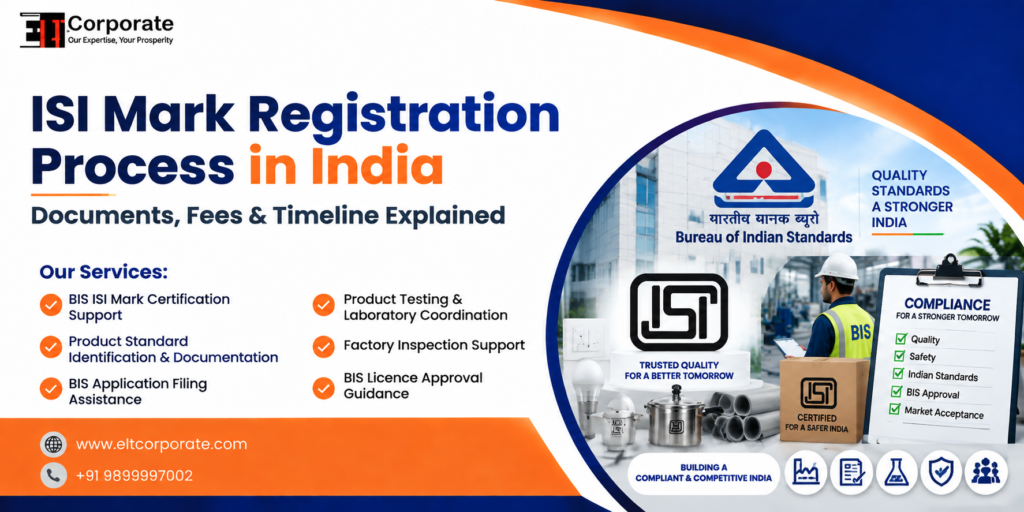
The ISI Mark Registration Process in India is an important certification procedure for manufacturers who want to prove that their products comply with the applicable Indian Standards defined by the Bureau of Indian Standards (BIS). The ISI Mark indicates that a product has successfully met the required quality, safety and performance parameters as per the relevant Indian Standard (IS).
Many products in India, such as electrical appliances, construction materials, steel products, kitchen appliances, cement, and various consumer goods, require mandatory BIS certification under applicable Quality Control Orders (QCOs). Manufacturers must obtain a BIS licence before using the ISI Mark on their products.
This complete guide explains the ISI Mark Registration Process in India, required documents, government fees, testing requirements, inspection process and approval timeline.
What is ISI Mark Certification?
The ISI Mark is a certification mark issued by the Bureau of Indian Standards (BIS) that confirms a product conforms to the relevant Indian Standard specification.
The certification is provided under BIS Product Certification Scheme (Scheme-I), where manufacturers are required to maintain product quality, conduct testing and allow BIS inspection of their manufacturing facilities.
The ISI Mark helps customers identify products that meet defined quality and safety standards.
Who Needs ISI Mark Registration in India?
ISI Mark Certification is required for:
1. Indian Manufacturers
Indian manufacturers producing products covered under BIS mandatory certification requirements must obtain a BIS licence before selling such products in the Indian market.
2. Foreign Manufacturers
Foreign manufacturers exporting BIS-regulated products to India may require certification under applicable BIS schemes, including the Foreign Manufacturers Certification Scheme (FMCS), along with an Authorized Indian Representative.
3. Importers
Importers dealing with products covered under mandatory BIS requirements must ensure that the product manufacturer has the required BIS approval before importing and selling in India.
Products Requiring ISI Mark Certification
The requirement depends on the product category and applicable Indian Standard.
Some common categories include:
- Electrical appliances
- Cement products
- Steel and metal products
- Automotive components
- Pressure cookers
- Water heaters
- Pipes and fittings
- Household products
- Building materials
- Furniture products covered under BIS standards
The list of mandatory products is updated through BIS notifications and Quality Control Orders issued by relevant ministries.
Benefits of ISI Mark Certification
1. Builds Consumer Trust
The ISI Mark assures customers that the product complies with recognized quality standards.
2. Legal Compliance
For mandatory products, BIS certification is necessary before manufacturing, importing or selling in India.
3. Market Acceptance
ISI-certified products get better acceptance among customers, distributors and government procurement agencies.
4. Quality Improvement
The certification process encourages manufacturers to maintain consistent production quality.
ISI Mark Registration Process in India
The complete ISI Mark Registration Process involves multiple stages:
Step 1: Identify Applicable Indian Standard (IS Code)
The first step is identifying the correct Indian Standard applicable to your product.
The manufacturer needs to check:
- Product category
- Applicable IS number
- Testing requirements
- Manufacturing process requirements
Selecting the correct IS Standard is critical because testing and inspection depend on this requirement.
Step 2: Prepare Required Documents
The manufacturer must prepare all required technical and business documents before applying.
The documents generally include:
Company Documents
- Certificate of Incorporation
- GST Registration Certificate
- PAN Card
- Company registration proof
- Address proof of manufacturing unit
Manufacturing Documents
- Manufacturing process details
- Factory layout plan
- Machinery details
- Production capacity details
- Raw material details
- Quality control plan
Technical Documents
- Product specification
- Test reports (if applicable)
- Product drawings
- Technical datasheet
- Indian Standard compliance details
Quality Control Documents
- Quality control records
- Testing equipment details
- Calibration certificates
- Internal inspection reports
Step 3: Submit BIS Application Online
The manufacturer needs to submit an online application through the BIS certification portal along with required documents and applicable fees.
The application includes:
- Applicant details
- Manufacturing unit details
- Product details
- IS Standard details
- Testing laboratory information
Step 4: Product Testing
Product samples are tested in a BIS-recognized laboratory.
Testing verifies whether the product meets the requirements mentioned in the applicable Indian Standard.
Testing parameters depend on the product category.
Examples:
- Safety tests
- Performance tests
- Chemical tests
- Mechanical tests
- Electrical tests
Step 5: BIS Factory Inspection
After application review and testing, BIS officials conduct a factory inspection.
During inspection, BIS verifies:
- Manufacturing facilities
- Production process
- Quality control system
- Testing facilities
- Records maintained by manufacturer
Step 6: Grant of BIS Licence
After successful completion of:
✔ Document verification
✔ Product testing
✔ Factory inspection
BIS grants the licence allowing the manufacturer to use the ISI Mark on approved products.
Documents Required for ISI Mark Registration
| Category | Documents Required |
|---|---|
| Company Documents | Incorporation Certificate, GST, PAN |
| Factory Documents | Factory Address Proof, Layout Plan |
| Product Documents | Product Specification, Drawings |
| Technical Documents | Test Reports, Technical Data |
| Manufacturing Documents | Process Flow Chart, Machinery Details |
| Quality Documents | QC Plan, Calibration Certificates |
| Personnel Details | Technical Staff Details |
ISI Mark Certification Fees in India
The total cost of ISI Mark Certification depends on:
- Product category
- Testing requirements
- Factory location
- Inspection requirements
- Laboratory charges
Typical fee components include:
| Fee Component | Approximate Cost |
|---|---|
| Application Fee | ₹1,000 |
| Processing Fee | Applicable as per BIS fee structure |
| Factory Inspection Fee | Approx. ₹7,000 per man-day |
| Product Testing Charges | Depends on product & laboratory |
| Annual Licence Fee | Applicable as per BIS rules |
| Marking Fee | Based on product category and production volume |
Note: Government fees may change according to BIS notifications and product category.
ISI Mark Registration Timeline
The timeline depends on:
- Completeness of documents
- Product testing duration
- Factory inspection schedule
- BIS processing time
Generally, the process may take around:
Normal Procedure:
45–90 days approximately
Factors affecting timeline:
- Delay in document submission
- Testing failures
- Additional product requirements
- Inspection scheduling
A faster process is possible when documentation and testing are properly prepared.
Difference Between BIS Certificate and ISI Mark
| BIS Certification | ISI Mark |
|---|---|
| Issued by Bureau of Indian Standards | Mark displayed on certified products |
| Covers multiple certification schemes | Mainly associated with Product Certification Scheme-I |
| Confirms compliance with standards | Indicates certified product conformity |
Common Reasons for ISI Mark Application Rejection
Manufacturers should avoid:
❌ Incorrect IS Standard selection
❌ Incomplete documentation
❌ Failed product testing
❌ Poor quality control system
❌ Missing factory records
❌ Non-compliance during inspection
Why Choose ELT Corporate for ISI Mark Registration?
ELT Corporate provides complete assistance for BIS ISI Mark Certification, including:
✔ Product standard identification
✔ Documentation preparation
✔ BIS application filing
✔ Testing coordination
✔ Factory inspection support
✔ Compliance guidance
Our experts help manufacturers complete the certification process smoothly and efficiently.
Conclusion
The ISI Mark Registration Process in India is essential for manufacturers dealing with BIS-regulated products. Obtaining ISI certification ensures compliance with Indian Standards, improves product credibility and allows businesses to legally manufacture and sell certified products in India.
A successful application requires proper documentation, product testing, factory compliance and coordination with BIS requirements. Manufacturers should begin the process by identifying the correct Indian Standard and preparing all necessary technical documents.
Frequently Asked Questions (FAQs)
1. What is ISI Mark Certification?
ISI Mark Certification is a BIS approval that confirms a product complies with the applicable Indian Standard.
2. Is ISI Mark mandatory in India?
Yes, ISI Mark is mandatory for products notified under BIS mandatory certification requirements.
3. How much time does ISI Mark registration take?
Generally, ISI certification may take around 45–90 days depending on product testing and inspection requirements.
4. What documents are required for ISI Mark Registration?
Documents include company details, factory documents, product specifications, testing documents and quality control records.
5. Who issues the ISI Mark?
The ISI Mark is issued by the Bureau of Indian Standards (BIS).