

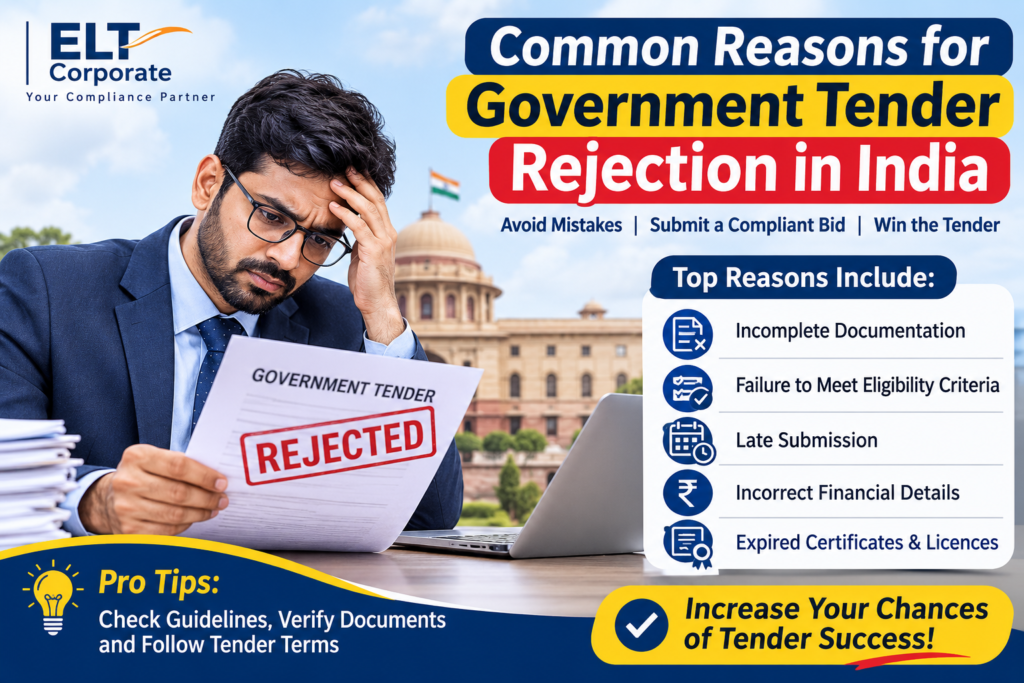
Government tenders provide excellent business opportunities for contractors, manufacturers, suppliers, service providers, and companies looking to work with government departments in India. Through government procurement, businesses can participate in infrastructure projects, supply goods, provide professional services, and secure long-term contracts.
However, submitting a government tender does not guarantee selection. Many applications are rejected during the technical evaluation or financial evaluation stage because of incomplete documentation, incorrect information, failure to meet eligibility criteria, or non-compliance with tender conditions.
Understanding the common reasons for government tender rejection in India is important for every business planning to participate in government procurement.
Even a small documentation mistake can result in disqualification, regardless of the company’s experience or ability to complete the project.
In this guide, we will explain the 15 most common reasons for government tender rejection in India, important documentation requirements, mistakes to avoid, and practical tips to improve your chances of successful tender submission.
What Is Government Tender Rejection?
Government tender rejection refers to the disqualification or non-acceptance of a bidder’s tender application by the concerned government department or procuring authority.
A tender can be rejected during different stages of the procurement process, including:
- Initial document verification.
- Technical bid evaluation.
- Financial bid evaluation.
- Eligibility assessment.
- Compliance verification.
The procuring authority evaluates each application common reasons for government tender rejection in India according to the eligibility criteria, technical specifications, financial requirements, and conditions mentioned in the tender document.
Businesses should carefully review all tender requirements before submitting their applications.
Common Reasons for Government Tender Rejection in India
Understanding the Common Reasons for Government Tender Rejection in India can help businesses identify potential problems before submitting their bids.
Below are 15 serious mistakes that applicants should avoid.
1. Incomplete Tender Documentation
One of the most common reasons for government tender rejection in India is incomplete documentation.
Government departments generally require bidders to submit specific documents to establish their legal identity, financial capacity, technical experience, and eligibility.
Missing documents may lead to rejection if the deficiency is not permitted to be corrected under the tender conditions.
Before submission, prepare a complete checklist of the required documents and verify every attachment.
2. Failure to Meet Eligibility Criteria
Every government tender includes eligibility conditions that bidders must satisfy.
These conditions may include:
- Minimum business experience.
- Required annual turnover.
- Previous project experience.
- Relevant registrations and licences.
- Financial capacity.
- Technical qualifications.
If a company does not meet the prescribed eligibility conditions, its bid may be rejected during technical evaluation.
Businesses should carefully examine the common reasons for government tender rejection in India eligibility section before investing time and resources in preparing a tender application.
3. Incorrect or Invalid GST Details
GST registration details are commonly required in government procurement.
Incorrect GSTIN information, mismatched business details, or invalid registration information can create problems during document verification.
Applicants should ensure that their GST registration certificate contains accurate business information and matches the details provided in the tender application.
4. Expired Registration Certificates and Licences
Submitting expired registration certificates is another important reason for government tender rejection in India.
Depending on the nature of the tender, bidders may need valid documents such as
- GST Registration Certificate.
- PAN Card.
- Udyam Registration Certificate, where applicable.
- Relevant industry licences.
- Contractor registration.
- Professional certifications.
Always check the validity of the required certificates before uploading them.
5. Incorrect Financial Information
Financial capacity is an important factor in government tender evaluation.
Many tenders specify minimum turnover, financial stability, and other financial requirements.
Providing incorrect turnover figures, inconsistent common reasons for government tender rejection in India financial statements, or unsupported financial information can affect the eligibility assessment.
Applicants should ensure that their financial information is supported by the required audited statements, CA certificates, or other documents specified in the tender.
6. Failure to Submit Earnest Money Deposit (EMD)
Earnest Money Deposit (EMD) is a security amount that may be required from bidders to demonstrate their seriousness and commitment to the tender process.
Depending on the tender conditions, applicants may need to submit common reasons for government tender rejection in India through an accepted payment method or provide an eligible exemption document.
Common mistakes include:
- Not submitting the required EMD.
- Paying an incorrect amount.
- Using an unacceptable payment method.
- Submitting an invalid bank guarantee.
- Failing to provide the required exemption proof.
Bidders should carefully check the EMD conditions before submitting their applications.
7. Incorrect Technical Bid Submission
A technical bid explains how a bidder will meet the requirements of the government project.
It may include technical specifications, work methodology, manpower details, equipment information, previous experience, and other supporting documents.
If the technical proposal does not satisfy the common reasons for government tender rejection in India specifications mentioned in the tender, the application may be rejected.
Applicants should prepare their technical bids according to the exact requirements of the procuring authority.
8. Missing Previous Work Experience Documents
Many government tenders require bidders to demonstrate experience in completing similar projects.
Relevant supporting documents may include:
- Work orders.
- Purchase orders.
- Completion certificates.
- Performance certificates.
- Client references.
- Project experience statements.
Submitting insufficient or irrelevant experience is a common reasons for government tender rejection in India documents may result in disqualification if the bidder fails to meet the prescribed experience criteria.
9. Incorrect Tender Fee Payment
Some government tenders require bidders to pay a tender processing fee or document fee.
If the required fee is not paid correctly within the specified period, the application may be rejected.
Applicants should verify the payment amount, payment method, transaction details, and deadline mentioned in the tender notice.
10. Uploading Incorrect or Unreadable Documents
Government e-procurement portals generally require documents in specified digital formats and file sizes.
Uploading common reasons for government tender rejection in India corrupted, incomplete, password-protected, or unreadable files can create verification problems.
Before final submission, ensure that:
- All documents open properly.
- Scanned copies are clear.
- Required pages are included.
- File formats follow portal instructions.
- File sizes are within permitted limits.
Failure to Follow Technical Specifications
Government procurement authorities specify detailed technical requirements for goods, services, and projects.
For example, a tender for medical equipment—common reason for government tender rejection in India may specify product standards, technical specifications, certifications, and performance requirements.
If the offered product or service does not meet the prescribed conditions, the bid may be rejected.
Businesses should prepare a compliance statement mapping each tender specification to the relevant product or service information.
Incorrect Information in the Tender Application
Providing inconsistent or incorrect information can create serious problems during evaluation.
Examples include
- Different company names across documents.
- Incorrect registered addresses.
- Mismatched PAN and GST information.
- Incorrect turnover details.
- Inaccurate project experience.
- Unsupported declarations.
Always cross-check the common reasons for government tender rejection in India information in the application against official business records.
Missing Digital Signature Certificate (DSC)
Many government e-procurement platforms require an appropriate Digital Signature Certificate (DSC) for online bid submission.
An expired, incorrectly common reasons for government tender rejection in India configured, or incompatible DSC may prevent successful submission.
Businesses should check the portal’s current DSC requirements and ensure that the authorized signatory can complete the signing process before the deadline.
Late Submission of Tender Application
Missing the tender submission deadline is a major reason for disqualification.
Government e-procurement portals generally follow strict submission timelines.
Even if all documents are ready, uploading them at the common reasons for government tender rejection in India last minute can create problems due to internet issues, payment delays, or technical errors.
Submit the application well before the closing date and verify the final submission acknowledgement.
Violation of Tender Terms and Conditions
Every tender contains specific terms and conditions that bidders must follow.
These may include confidentiality requirements, declarations, conflict-of-interest conditions, restrictions on participation, and other contractual obligations.
Failure to comply with applicable common reasons for government tender rejection in India tender conditions can result in rejection or other consequences under the procurement rules.
Applicants should read the complete tender document instead of focusing only on the financial and technical sections.
Documents Required to Avoid Government Tender Rejection in India
Proper documentation plays a significant role in successful tender participation.
Although the exact requirements vary, common reasons for government tender rejection in India according to the department, project, and tender category, businesses may need the following documents:
| Document | Purpose |
| PAN Card | Business identity verification |
| GST Registration Certificate | GST registration verification |
| Certificate of Incorporation | Legal business registration |
| Udyam Registration | MSME status, where applicable |
| Income Tax Returns | Financial and tax information |
| Audited Financial Statements | Financial capacity assessment |
The above is a general checklist. Not every tender requires all these documents. Always follow the specific tender notice and its latest amendments.
How to Avoid Government Tender Rejection in India
After understanding the common reasons for common reasons for government tender rejection in India, businesses should follow a systematic approach to reduce avoidable errors.
1. Read the Complete Tender Document.
Carefully review the eligibility criteria, technical specifications, financial requirements, submission instructions, and deadlines.
2. Prepare a Document Checklist
Create a checklist based on the common reasons for government tender rejection in India tender requirements and arrange all documents before beginning the application.
3. Verify Business Information
Check that company names, PAN, GSTIN, registered addresses, and other details match across all documents.
4. Check Certificate Validity
Ensure that all required registrations, licences, and certificates are valid on the relevant dates common reasons for government tender rejection in India specified in the tender.
5. Review Technical and Financial Bids Separately
Prepare the technical and financial proposals carefully and follow the prescribed submission format.
6. Verify EMD and Tender Fee Requirements
Confirm payment amounts, exemption eligibility, accepted methods, and supporting proof.
7. Complete Submission Before the Deadline
Avoid last-minute submission. Save the acknowledgement and verify that the common reasons for government tender rejection in India have been successfully submitted.
Why Professional Tender Documentation Support Matters
Government tender preparation involves more than filling out an application form. Businesses must understand eligibility conditions, organize supporting documents, prepare technical proposals, and follow procurement instructions.
Professional tender documentation support can help organizations:
- Review tender eligibility requirements.
- Prepare document checklists.
- Organize business registration documents.
- Check documentation consistency.
- Prepare supporting declarations.
- Coordinate technical and financial documentation.
- Review applications before submission.
ELT Corporate provides business and compliance consulting support to organisations that need assistance with documentation and regulatory processes.
Professional assistance can help businesses improve common reasons for government tender rejection in India documentation quality and reduce avoidable errors. However, final acceptance and selection always depend on the procuring authority and the applicable tender conditions.
Conclusion
Understanding the Common Reasons for Government Tender Rejection in India is essential for businesses that want to participate successfully in government procurement.
Incomplete documents, incorrect business information, financial eligibility issues, missing EMD, technical non-compliance, and late submission are some of the major mistakes that bidders should avoid.
A well-prepared tender application begins with understanding the tender requirements, checking eligibility, organising the necessary documents, and reviewing the complete application before submission.
Businesses should treat tender common reasons for government tender rejection in India documentation as an important part of their procurement strategy rather than a last-minute administrative task.
Frequently Asked Questions
Q1. What Are the Common Reasons for Government Tender Rejection in India?
Common reasons include incomplete documentation, failure to meet eligibility criteria, and incorrect financial information
Q2. Can a Government Tender Be Rejected Due to Missing Documents?
Yes. If mandatory documents are missing and the tender conditions do not permit correction or clarification, it may be rejected.
Q3. Is GST Registration Mandatory for Every Government Tender?
GST requirements depend on the tender conditions and applicable laws.
Q4. What Is the Role of EMD in Government Tenders?
EMD is a security deposit that may be required to demonstrate a bidder’s seriousness.
Q5. Can I Submit Missing Documents After the Tender Deadline?
Not necessarily. Whether a clarification or additional document can be accepted depends on the applicable procurement rules and tender conditions.