
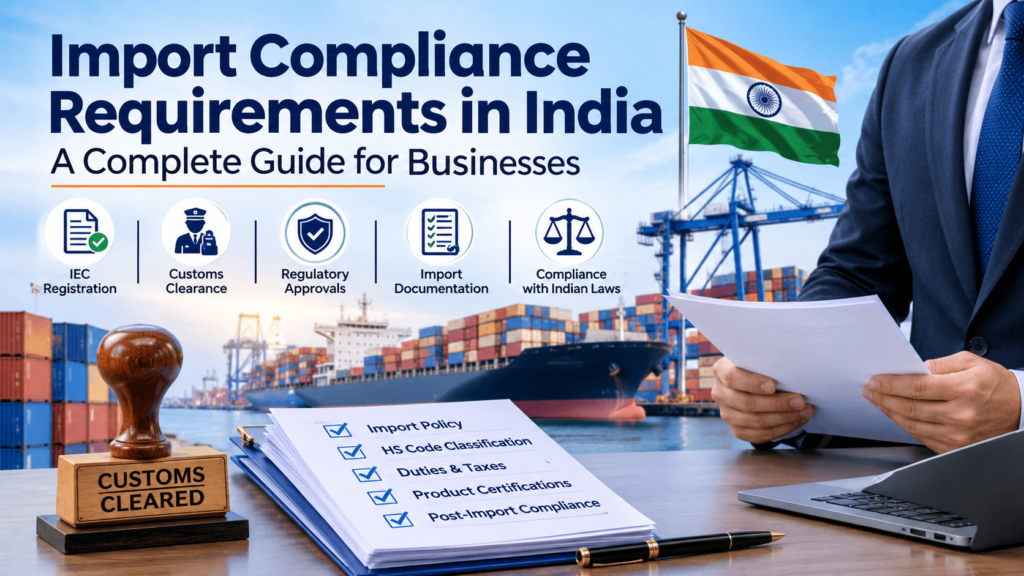
India is one of the world’s major markets for international trade, attracting businesses, manufacturers, suppliers, and foreign investors from different countries. Companies importing products into India must follow various legal, customs, taxation, and product-specific regulations before bringing goods into the Indian market.
Understanding import compliance requirements in India is essential for businesses to avoid customs delays, penalties, shipment rejection, and unnecessary financial losses.
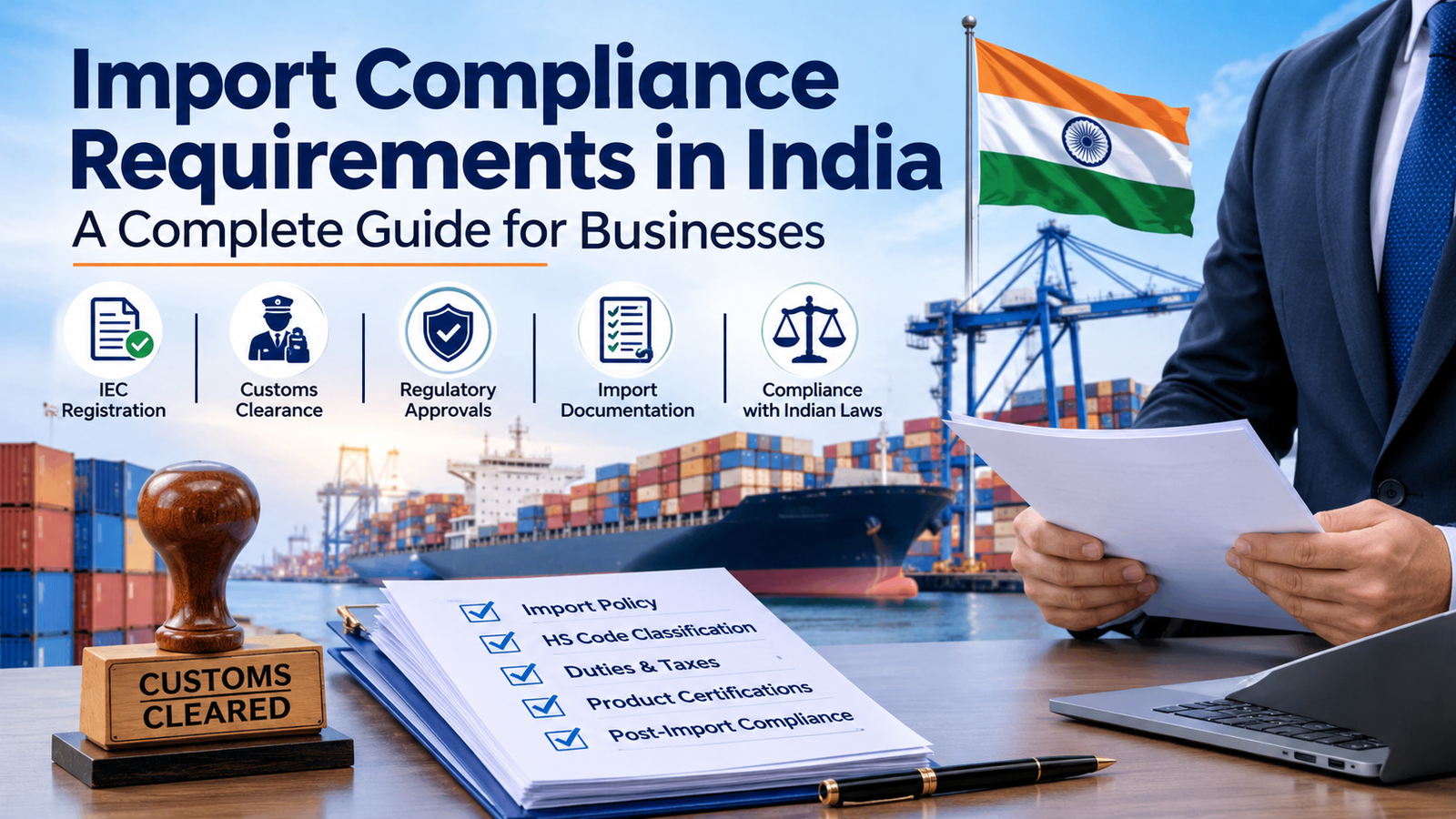
Import compliance involves obtaining the necessary registrations, checking import policies, preparing documentation, paying applicable customs duties, and securing regulatory approvals for specific products.
Whether you are a new importer, an established trading company, or a foreign manufacturer planning to enter the Indian market, understanding the Import Compliance Requirements in India can help you manage your import operations smoothly.
In this guide, we explain the major import regulations, registrations, documentation requirements, and compliance procedures that businesses should understand before importing goods into India.
What Are Import Compliance Requirements in India?
Import Compliance Requirements in India refer to the legal procedures, government regulations, registrations, and documentation that businesses must follow when importing goods from other countries into India.
These requirements are governed by different Indian authorities, including:
- Directorate General of Foreign Trade (DGFT)
- Central Board of Indirect Taxes and Customs (CBIC)
- Indian Customs Department
- Bureau of Indian Standards (BIS)
- Food Safety and Standards Authority of India (FSSAI)
- Central Drugs Standard Control Organisation (CDSCO)
- Legal Metrology Department
The applicable requirements depend on the nature of the imported product, its classification, country of origin, and intended use.
Businesses should identify all applicable regulations before placing an import order or shipping goods to India.
Obtain Importer Exporter Code (IEC) Registration
One of the first steps in meeting the Import Compliance Requirements in India is obtaining an Importer Exporter Code (IEC).
IEC is a business identification number issued by the Directorate General of Foreign Trade (DGFT). It is generally mandatory for businesses undertaking commercial imports into India, subject to specified exemptions.
Why Is IEC Registration Important?
IEC registration helps businesses:
- Undertake commercial import activities.
- Complete customs clearance procedures.
- Conduct international trade transactions.
- Maintain their importer identification details.
- Complete applicable foreign trade formalities.
How to Obtain IEC Registration?
Businesses can generally follow these steps:
- Visit the official DGFT website.
- Register or log in to the DGFT portal.
- Select the IEC application service.
- Enter the required business and applicant information.
- Upload the applicable documents.
- Pay the prescribed application fee.
- Submit the application and track its status.
IEC holders should also complete the prescribed annual IEC confirmation or updation during the April–June period, even when there are no changes in their details.
Identify the Correct HS Code for Imported Products
Correct product classification is another important part of the import compliance requirements in India.
The Harmonized System (HS) Code, used within India’s ITC (HS) classification system, helps identify imported goods and determine their applicable customs duties, import policy conditions, and regulatory requirements.
Every product must be classified according to its technical characteristics, composition, function, and intended use.
Why Is HS Code Classification Important?
Correct classification helps businesses:
- Determine applicable customs duty rates.
- Identify restricted or prohibited products.
- Check product-specific import conditions.
- Understand applicable regulatory approvals.
- Prepare accurate customs declarations.
Incorrect classification may result in incorrect duty payment, customs queries, penalties or shipment delays.
Importers should verify the applicable ITC (HS) classification before shipping goods to India.
Check the Import Policy and Restrictions
Before importing any product, businesses must check its import compliance requirements in India import policy under India’s Foreign Trade Policy and ITC (HS) classification.
Based on the applicable policy conditions, products may fall into different categories.
Free Import Products
These products can generally be imported without a specific DGFT import authorization, subject to applicable customs and other regulatory requirements.
Restricted Import Products
Certain products require an import authorization or permission from the relevant government authority before import.
Prohibited Import Products
Some products are not permitted to be imported into India, subject to applicable exceptions or specific government notifications.
State Trading Enterprise (STE) Products
Certain goods are subject to exclusive or special trading arrangements through designated State Trading Enterprises.
Checking the import policy in advance helps businesses understand the applicable import compliance requirements in India and avoid importing goods without the required permission.
Obtain Product-Specific Licences and Regulatory Approvals
Not every imported product follows the same compliance procedure. Certain products require additional licences, registrations, certificates, or No Objection Certificates (NOCs).
Businesses must identify the applicable regulatory authority before importing their products.
Some important examples include:
BIS Certification
Certain products covered under applicable Quality Control Orders (QCOs) must comply with relevant Bureau of Indian Standards requirements.
Depending on the applicable product and certification scheme, manufacturers may need the required BIS licence or registration before the goods can be imported or sold in India.
FSSAI Registration and Food Import Clearance
Businesses importing food products import compliance requirements in India must comply with applicable Food Safety and Standards regulations.
Depending on the business and product category, importers may require the relevant FSSAI licence and food import clearance through the Food Import Clearance System (FICS).
CDSCO Registration and Approval
Medical devices, cosmetics, and pharmaceutical products may require specific registrations, licences or approvals under the applicable Indian regulatory framework.
For example:
- Imported cosmetics may require registration under the Cosmetics Rules, 2020.
- Imported medical devices must comply with applicable Medical Devices Rules, 2017 requirements.
- Pharmaceutical imports must meet relevant drug regulatory requirements.
Legal Metrology Compliance
Importers dealing with pre-packaged commodities must examine the applicable Legal Metrology (Packaged Commodities) Rules, 2011.
These rules prescribe relevant declarations on product packages, such as importer details, country of origin, net quantity, and other applicable information.
Obtaining the correct approvals is an essential part of Import Compliance Requirements in India, particularly for regulated products.
Prepare the Mandatory Import Documentation
Proper documentation is necessary for smooth customs clearance and compliance with Indian import regulations.
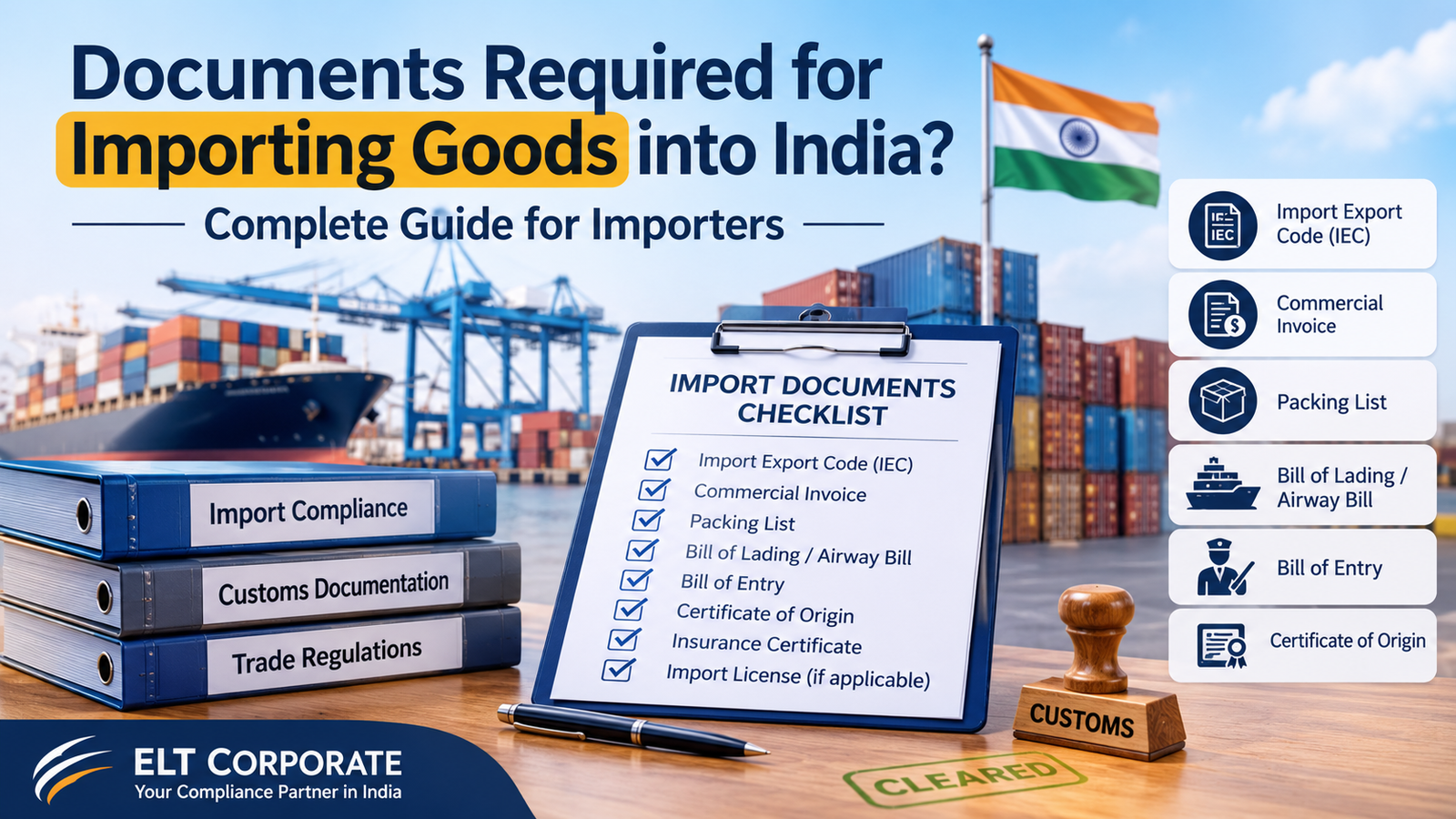
Under India’s Foreign Trade Policy, the key mandatory documents for importing goods generally include
A. Bill of Entry
A bill of entry is a customs declaration submitted by the importer compliance requirements in India for imported goods.
It contains important information, including:
- Importer details.
- Product description.
- HS Code.
- Declared product value.
- Country of origin.
- Applicable customs duties.
It is generally filed electronically through the Indian Customs system.
B. Commercial Invoice Cum Packing List
This document provides details about the commercial transaction and shipment.
It generally includes:
- Seller and buyer information.
- Product description.
- Quantity and unit price.
- Total invoice value.
- Currency.
- Packaging details.
- Gross and net weight.
C. Bill of Lading or Air Waybill
This is a transport document issued by the shipping or airline carrier.
It provides shipment-related information, including the consignor, consignee, transportation details, and description of the goods.
Additional Supporting Documents
Depending on the nature of the imported products, businesses may also need:
- Certificate of Origin.
- Insurance documents.
- Import licence or authorization.
- Product test reports.
- Technical specifications.
- Regulatory approvals and NOCs.
- Purchase orders.
- Product catalogues.
- Other supporting declarations.
The additional documents depend on applicable customs requirements and product-specific regulations.
Complete Customs Clearance Procedures
Customs clearance is a major stage of import compliance requirements in India.
Imported goods must complete the applicable customs assessment and clearance formalities before being released for domestic consumption.
Steps Involved in Customs Clearance
Step 1: Arrival of Goods
Imported goods arrive at the designated Indian seaport, airport, or other authorized customs location.
Step 2: Filing of Bill of Entry
The importer or authorized customs broker submits the Bill of Entry through the applicable customs electronic system.
Step 3: Document Verification
Customs authorities examine the declarations and supporting documents.
Step 4: Customs Assessment
The declared import compliance requirements in India product classification, valuation, import policy conditions, and applicable duties are assessed.
Step 5: Inspection or Examination
Depending on the applicable risk assessment and regulatory requirements, customs authorities may examine the imported goods.
Step 6: Payment of Customs Duties
The importer pays the applicable customs duties and other charges.
Step 7: Customs Clearance
After completion of the required formalities, customs authorities grant the applicable clearance for release of goods.
Businesses should ensure that all information submitted during customs clearance is accurate and supported by valid documents.
Understand Customs Duties and Taxes
Importers must understand the applicable customs duties and taxes before finalising their import transactions.
The duty structure depends on the import compliance requirements in India product’s classification, assessable value, country of origin, and applicable notifications or exemptions.
Some important components may include:
- Basic Customs Duty (BCD).
- Social Welfare Surcharge (SWS), wherever applicable.
- Integrated Goods and Services Tax (IGST).
- Applicable compensation cess, where relevant.
- Other applicable duties or levies.
Businesses should calculate the estimated landed cost of imported products before placing orders.
Proper duty calculation helps companies manage their import budgets and avoid unexpected financial expenses.
Follow Country of Origin and Trade Agreement Requirements
Country of origin is an important consideration under Import Compliance Requirements in India.
It identifies the country where a product was manufactured or produced according to the applicable rules of origin.
India has trade agreements with several countries and trading partners that may provide preferential customs duty benefits for eligible products.
However, businesses cannot claim preferential duty benefits simply because goods are shipped from a particular country.
They must satisfy the import compliance requirements in India, applicable rules of origin and provide the required Certificate of Origin and supporting documentation.
Importers should verify the relevant trade agreement conditions before claiming preferential customs duty benefits.
Maintain Post-Import Compliance and Records
Import compliance does not end after customs clearance.
Businesses must maintain relevant records and complete applicable post-import obligations.
Important activities may include:
- Maintaining import invoices and shipping documents.
- Keeping bills of entry and duty payment records.
- Maintaining product licenses and approvals.
- Completing applicable GST accounting and reporting.
- Following product labelling requirements.
- Meeting applicable product safety and quality standards.
- Maintaining records required under relevant laws.
- Complying with licence conditions and renewal requirements.
Proper record management helps businesses respond to regulatory inspections, audits, and compliance verification.
Common Challenges Businesses Face in Import Compliance
Companies may experience different challenges while managing import operations in India.
Some common problems include:
1. Incorrect HS Code Classification
Incorrect import compliance requirements in India product classification can lead to customs disputes, incorrect duty payments, and shipment delays.
2. Missing Regulatory Approvals
Importing regulated products without the necessary licences or approvals can result in clearance difficulties.
3. Incomplete Documentation
Missing invoices, incorrect declarations, or import compliance requirements in India incomplete supporting documents can delay customs processing.
4. Incorrect Product Labelling
Products that do not meet applicable Indian labelling requirements may face regulatory objections.
5. Changes in Import Regulations
Government notifications and product-specific compliance requirements may change. Businesses must regularly check applicable updates.
Working with experienced import compliance requirements in India regulatory and import compliance consultants can help companies identify these issues before shipment.
Import Compliance Checklist for Businesses in India
Before importing goods into India, businesses should review the following checklist:
- Obtain the required IEC registration or confirm the applicable exemption.
- Identify the correct ITC (HS) code.
- Check the current import policy.
- Verify whether the product is free, restricted, or prohibited.
- Identify applicable product-specific licences and approvals.
- Check BIS, FSSAI, CDSCO, or legal metrology requirements, wherever applicable.
- Prepare the commercial invoice and packing list.
Following this checklist can help businesses manage import compliance requirements in India more effectively.
How ELT Corporate Can Help with Import Compliance in India
Managing import regulations requires knowledge of customs procedures, trade policies, product-specific approvals, and applicable legal requirements.
ELT Corporate provides business consultancy and regulatory compliance support to companies planning to establish or expand their operations in India.
Our team helps businesses understand relevant compliance requirements, identify applicable registrations, and navigate regulatory procedures.
Our support areas include:
- Import regulatory compliance guidance.
- Business registration and corporate compliance.
- Assistance with applicable import licences and registrations.
- Product-specific regulatory compliance guidance.
- Documentation and application support.
- Coordination for relevant regulatory approvals.
- Ongoing compliance advisory.
Whether you are an Indian importer or an international company planning to enter the Indian market, understanding the applicable regulations is important for smooth business operations.
Visit ELT Corporate to explore our business and regulatory consultancy services: https://eltcorporate.com/in/
Conclusion
Understanding import compliance requirements in India is essential for every business involved in international trade.
From IEC registration and HS Code classification to product-specific approvals, customs documentation, duty payments, and post-import obligations, every stage requires proper attention.
Failure to follow applicable regulations may lead to shipment delays, financial penalties, customs disputes, and business interruptions.
Businesses should review the latest government notifications, verify product-specific requirements, and prepare the necessary documentation before importing goods.
With proper planning and professional regulatory guidance, companies can manage their import operations more efficiently and maintain compliance with Indian laws.
Frequently Asked Questions
Q1. What are import compliance requirements in India?
Import Compliance Requirements in India are the legal registrations, licenses, documentation when importing goods into India.
Q2. Is IEC mandatory for importing goods into India?
IEC is generally mandatory for commercial imports into India under foreign trade regulations.
Q3. Which documents are required for importing goods into India?
The key mandatory documents generally include the import compliance requirements in India Bill of Entry, commercial invoice cum packing list, and Bill of Lading or Air Waybill.
Q4. What is the role of DGFT in import compliance?
The Directorate General of Foreign Trade regulates India’s foreign trade framework, issues IECs, and administers import foreign trade policy requirements.
Q5. Is BIS certification required for all imported products?
No. BIS certification or registration is required for products covered under applicable mandatory certification requirements and Quality Control Orders.